The Tournée du Chat Noir poster is a lithograph by Théophile-Alexandre Steinlen, printed in 1896 to announce the tour of the troupe of Rodolphe Salis’s Montmartre cabaret. Its large seated black cat, with a red halo and yellow eyes, has become one of the most reproduced images of the Belle Époque.
The poster, detail by detail
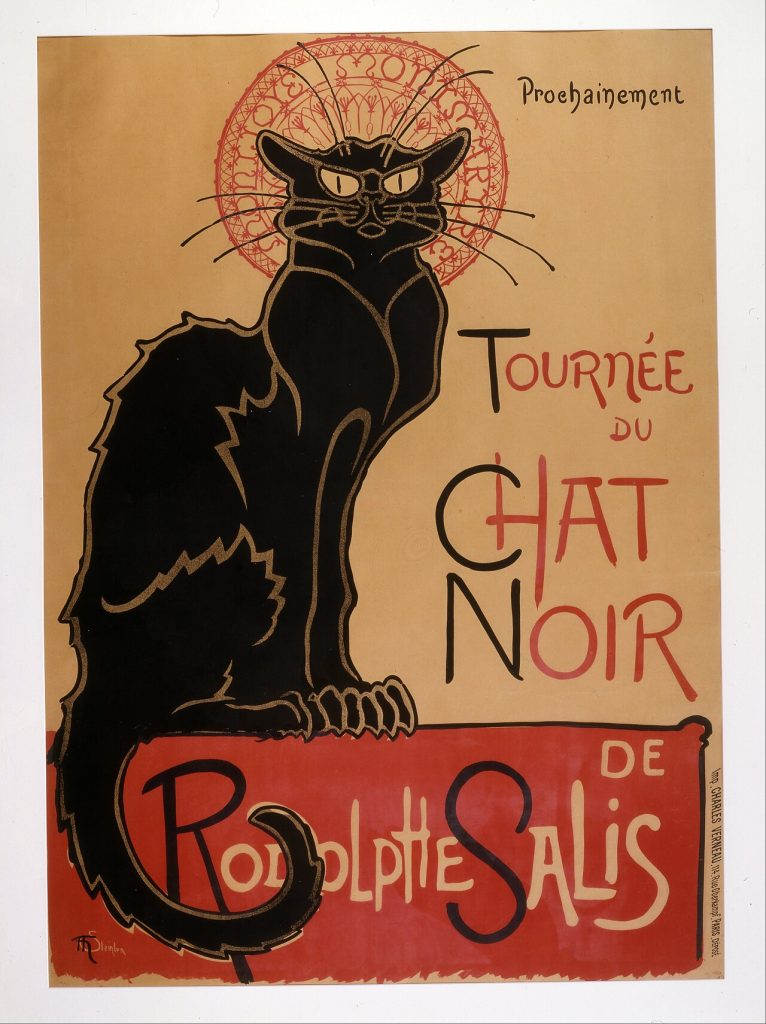
| Element | What you see | What it says |
|---|---|---|
| The cat | A seated black cat, drawn in a flat shape outlined in gold | The cabaret’s emblem, readable from across the street |
| The halo | An ornate red circle behind its head, like an icon | Often read as an ironic wink: the mascot of bohemian Montmartre becomes a saint |
| The gaze | Yellow almond eyes staring at the passer-by | A face-to-face that stops you in your tracks |
| The lettering | Hand-drawn letters in red and black | The text is part of the picture |
| The band | A flat red band the cat sits on, with the name of Rodolphe Salis | The cabaret owner, in large letters, like a star |
| “Prochainement” | A discreet word in the top right corner, meaning “coming soon” | The poster announces an upcoming tour |
The poster was printed in lithography by the Charles Verneau printing house, whose name appears in small letters on the side. There are two versions, one reading “de Rodolphe Salis” (by Rodolphe Salis), the other “avec Rodolphe Salis” (with Rodolphe Salis).
The Chat Noir, a Montmartre cabaret
Le Chat Noir (The Black Cat) opened on 18 November 1881 at 84 boulevard de Rochechouart, at the foot of the Montmartre hill. Its founder, Rodolphe Salis, had the idea of combining art and a drinking establishment. The name is said to come from a stray black cat found on the pavement during the building work. Poets, songwriters and painters flocked there, and Salis installed a piano, a first for a cabaret: this is where cabaret song was born.
| Date | What happened |
|---|---|
| November 1881 | Rodolphe Salis opens the Chat Noir at 84 boulevard de Rochechouart |
| 1882 | Launch of the weekly magazine Le Chat Noir, published until 1895 |
| June 1885 | The cabaret moves to a three-storey building at 12 rue de Laval (now rue Victor-Massé) |
| 1896 | Steinlen designs the poster for the Tournée du Chat Noir |
| 19 March 1897 | Rodolphe Salis dies: the cabaret closes shortly afterwards |
| 1907 | A new Chat Noir opens at 68 boulevard de Clichy |
On rue de Laval, Salis and the artist Henri Rivière created a colour shadow theatre that made the place famous. Aristide Bruant, Alphonse Allais, Erik Satie, Claude Debussy and Paul Verlaine were regulars, as was Henri de Toulouse-Lautrec.
Steinlen, the artist of cats
- His origins: born in 1859 in Lausanne, Switzerland, he studied theology for two years, then trained in industrial textile design in Mulhouse.
- Montmartre: he settled in Paris in 1881, lived on the hill from 1883 and went to the Chat Noir from 1884, where he became friends with Toulouse-Lautrec and Aristide Bruant.
- The illustrator: he drew for Gil Blas illustré, Le Rire and L’Assiette au beurre, whose very first cover he designed in 1901.
- The committed artist: close to anarchist circles, he drew the hardship of the streets, the factories and the mines, and the life of soldiers during the First World War.
- The cat lover: he drew them endlessly, playful, asleep or angry, and also sculpted them in bronze.
- The end: he became a French citizen in 1901, died on 13 December 1923 at his home at 73 rue Caulaincourt and is buried in the Saint-Vincent cemetery, in Montmartre.
Why did the Chat Noir poster become a cult image?
- A strikingly simple image: a black silhouette on a light background, three colours and a gaze. You recognise it at a glance, even tiny.
- The symbol of an era: the black cat sums up Montmartre, its cabarets and its bohemian life at the end of the 19th century.
- An ambiguous animal: bad luck for some, the artists’ companion for others, the black cat intrigues and amuses.
- A copyright-free poster: as Steinlen died in 1923, the image is in the public domain and now appears on mugs, bags and postcards all over the world.
Steinlen’s cats: 3 more works worth knowing
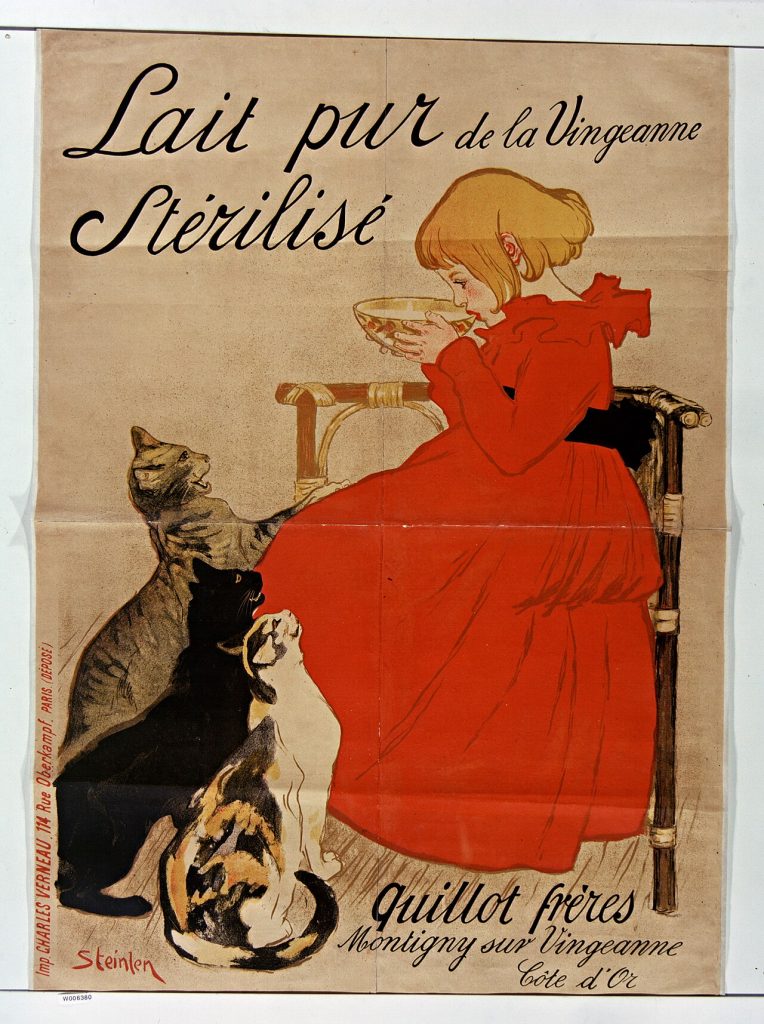
Lait pur stérilisé de la Vingeanne (1894)
A little girl in a red dress drinks a bowl of milk, while her cats, tabby, black or tortoiseshell, beg for their share at her feet. This advertisement for the Quillot brothers’ milk, from Montigny-sur-Vingeanne in Burgundy, is one of Steinlen’s most tender posters. His daughter Colette appears in much of his work.
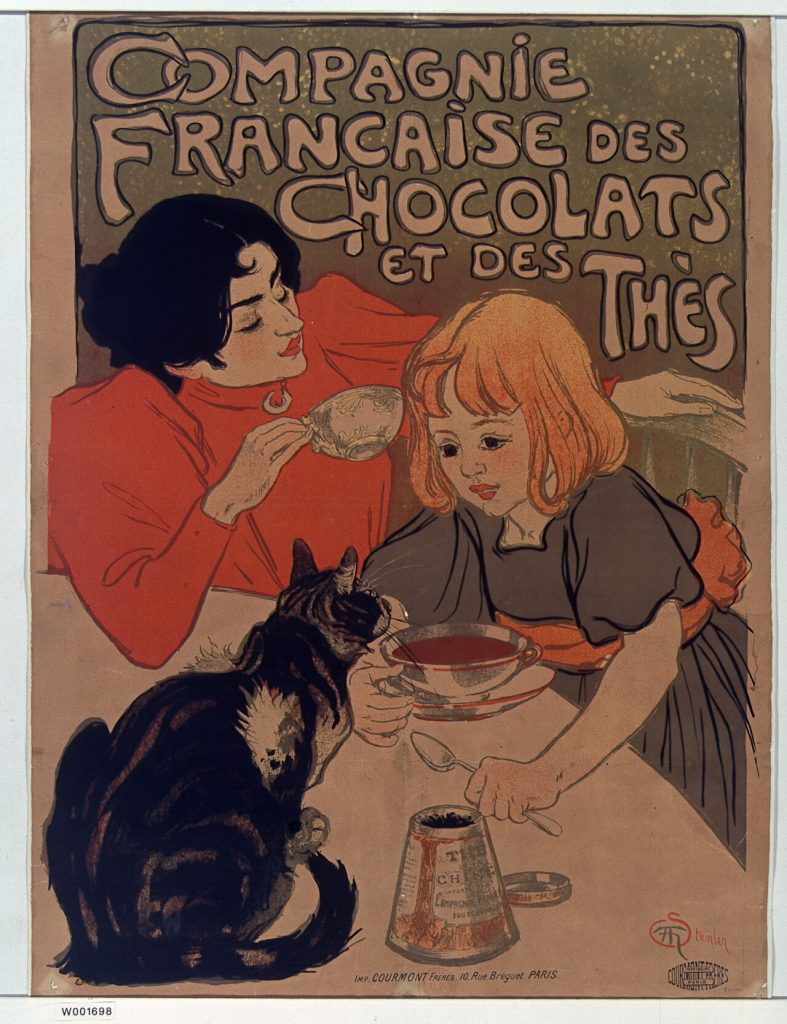
Compagnie française des chocolats et des thés (1895)
Around a table, a mother drinks her tea, a little girl holds her cup of hot chocolate and a tabby cat, seated in the foreground, eyes the bowl. The scene is familiar, almost a family snapshot: Steinlen sells a product by telling a moment of everyday life.
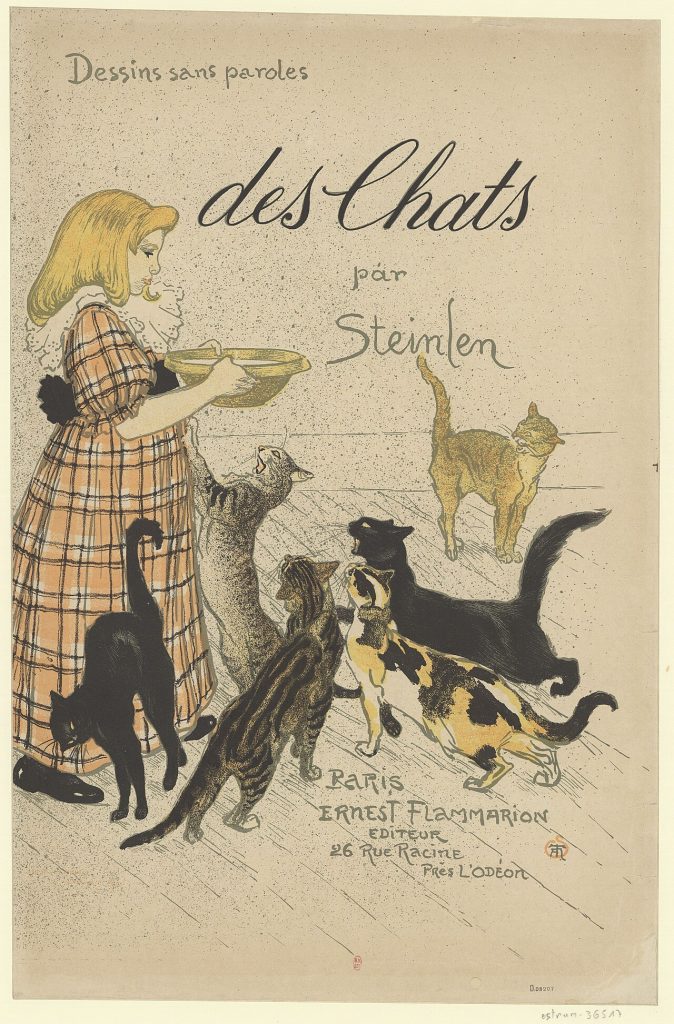
Des chats, dessins sans paroles (1898)
A whole album published by Flammarion, without a single word: short cat stories told only in pictures, like a comic strip before its time. On the cover, a little girl carries a bowl while six cats crowd around her. 🐾
Where can you see Steinlen’s Chat Noir in Paris?
- 68 boulevard de Clichy: at the address of the last Chat Noir, now a hotel, a neon sign features Steinlen’s cat.
- Rue Victor-Massé: the building of the second Chat Noir, at number 12, is gone, but a commemorative plaque recalls its story.
- The Musée de Montmartre: at 12 rue Cortot, it tells the story of the hill and its artists.
- Square Joël-Le Tac: the Steinlen fountain pays tribute to the artist, a short walk from the street named after him.
- The Saint-Vincent cemetery: Steinlen rests there, on the Montmartre hill.
- Gallica: the digital library of the Bibliothèque nationale de France lets you view his posters in high definition for free.
Outside Paris, the Petit Palais in Geneva holds 630 paintings, drawings and prints by Steinlen, the Musée Alphonse-Georges-Poulain in Vernon a collection of his works, and the Musée d’art et d’archéologie du Périgord in Périgueux four of his bronze cats.
A black cat on your wall
Steinlen’s poster has a strong personality: it likes plain walls and rooms that are lived in. A few tips to show it off.
- In a kitchen or a bistro corner: it recalls the cafés of Montmartre. It goes well with black and white tiles, bentwood chairs and a counter.
- A thin black frame: it extends the cat’s silhouette. A gilt frame also works, for a Belle Époque feel.
- A light or brick red wall: cream makes the black stand out, red echoes the band of the poster.
- As part of a series: pair it with two other posters from the same era, or with posters of Paris, to build a wall. Our gallery wall guide will help you find the balance.
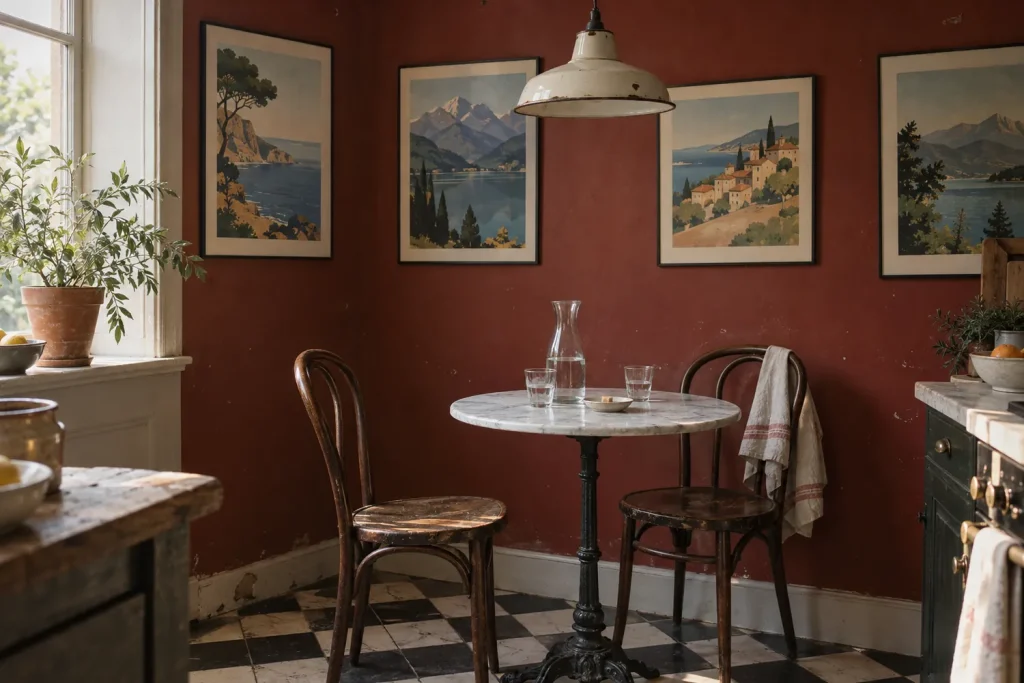
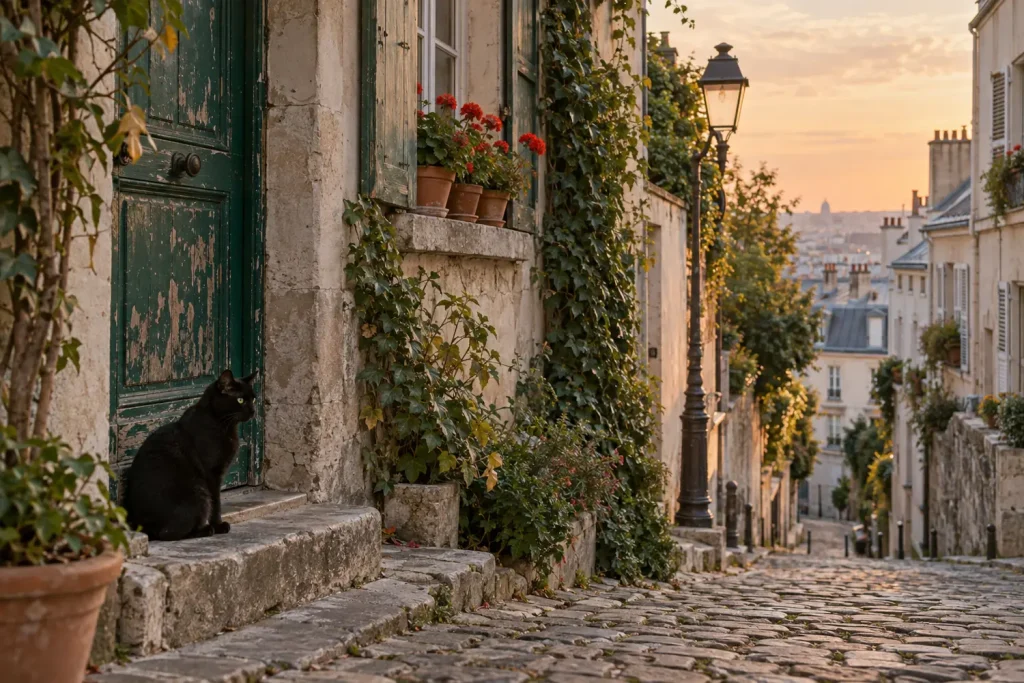
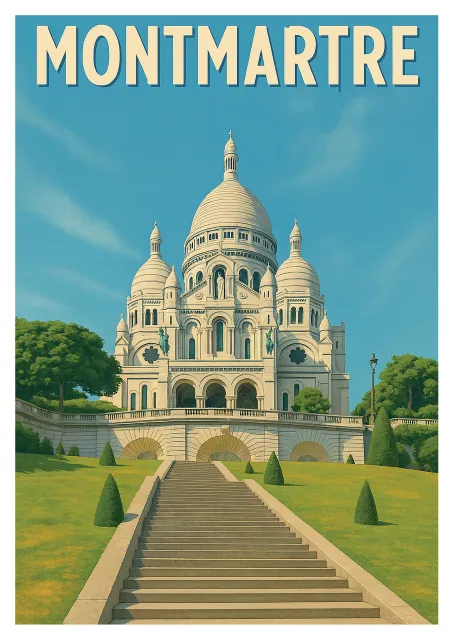
To echo the black cat of Montmartre, our Paris posters were born from our own photos, in the style of 1930s travel posters. The Sacré-Cœur watches over the hill where Steinlen spent his life.
Montmartre and Paris, in posters
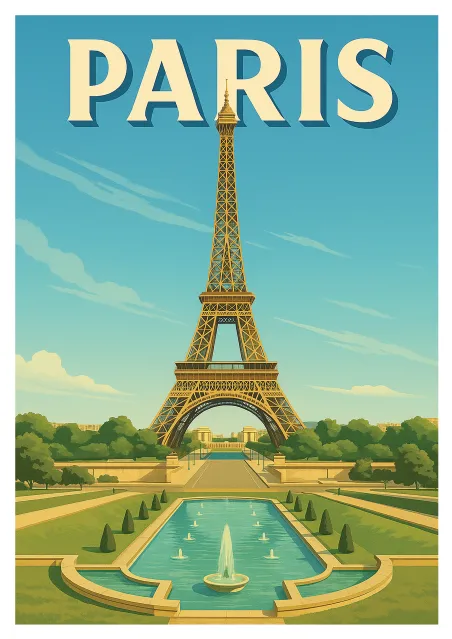
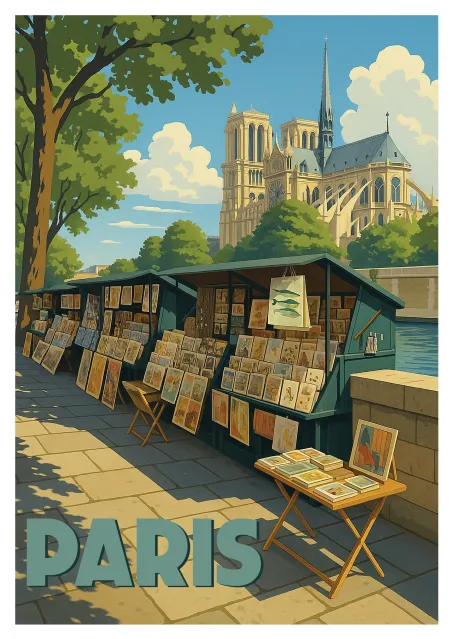
And if you love animals as much as Steinlen did, our Animals collection brings together other travel companions, from Edinburgh’s faithful Greyfriars Bobby to the reindeer of Lapland.
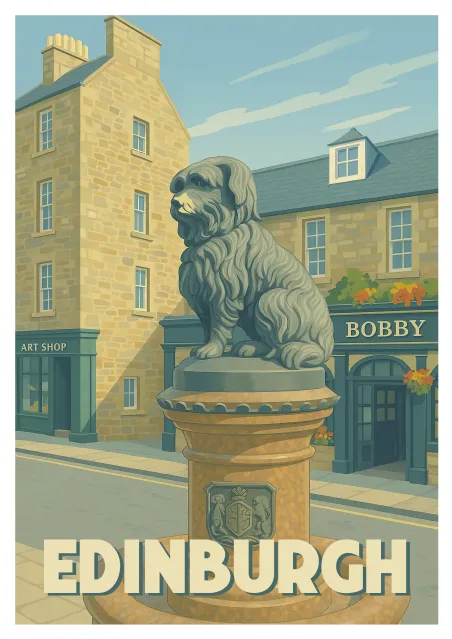


A cat that has not aged a day
More than a century after the cabaret closed, Steinlen’s cat still stares at us with its yellow eyes. It has outlived Rodolphe Salis, bohemian life and old Montmartre itself, because a simple, strong image never grows old. 🎨 To keep exploring the Belle Époque, read our article on Alphonse Mucha and Art Nouveau posters, find our other articles on poster art, and browse our animal posters.
Frequently asked questions
Who designed the Chat Noir poster?
The Tournée du Chat Noir poster was designed in 1896 by Théophile-Alexandre Steinlen (1859-1923), a Swiss artist who settled in Montmartre and became a French citizen in 1901. It announced the tour of the troupe of Rodolphe Salis’s cabaret.
What does Steinlen’s black cat mean?
The black cat is the emblem of Rodolphe Salis’s cabaret, said to be named after a stray cat found during the building work. On the poster, its red halo is often read as an ironic wink: the mascot of bohemian Montmartre becomes an icon.
Is the Chat Noir poster copyright-free?
Yes. In France, a work enters the public domain 70 years after its author’s death, on the following 1 January. As Steinlen died in 1923, his works have been in the public domain since 1 January 1994. A recent photograph of the poster may, however, have its own rights.
Where was the Chat Noir cabaret?
Le Chat Noir opened in 1881 at 84 boulevard de Rochechouart, then moved in 1885 to 12 rue de Laval, now rue Victor-Massé, in the 9th arrondissement of Paris. A new Chat Noir opened in 1907 at 68 boulevard de Clichy.