Cassandre (1901-1968), born Adolphe Mouron, is the great poster artist of Art Deco. His most famous posters are Au Bûcheron (1923), Étoile du Nord and Nord Express (1927), the Dubonnet triptych (1932) and the ocean liner Normandie (1935). His style: geometry, speed, and lettering that is part of the image.
Rather than a biography, we suggest a journey. Cassandre drew trains, ocean liners, cities and mountains, and ended up with a gondola in Venice. Let us follow him, stop by stop, from his first poster to one of his last.
Why are no Cassandre posters shown here? Cassandre died in 1968: his work remains under copyright in France until 1 January 2039. So we describe it in words. The Musée des Arts Décoratifs in Paris holds a large part of it.
Departure: a woodcutter in 1923
Adolphe Mouron was born on 24 January 1901 in Kharkov, in the Russian Empire, to French parents. He settled in Paris in 1915, studied painting and, to make a living, joined the Hachard printing works in 1922. There he signed his first advertisements, for a margarine and a brand of pasta, with a pseudonym: Cassandre.
A year later, for the furniture store Au Bûcheron, he drew a stylised woodcutter, cut into geometric shapes, a world away from the wordy advertisements of the time. In 1925 it won the grand prize at the International Exhibition of Decorative Arts, the very exhibition that gave Art Deco its name. He was 24. The same year, his poster for the newspaper L’Intransigeant showed a woman crying the news, with every line converging on her ear, as if the news of the world flowed in through the telegraph wires.
On the platform at the Gare du Nord, 1927
In 1927, a 23-year-old client changed everything. Maurice Moyrand, son of the director of the Northern Railway Company, commissioned two posters from Cassandre and, unusually, gave him a free hand. The result was two images that brought the French poster into the modern age.
Nord Express, for the International Sleeping-Car Company (Wagons-Lits), shows the locomotive from rail level: the wheels look taller than a man, the steel gleams under the airbrush, and the telegraph wires race towards a vanishing point pushed into a corner. No landscape, no passengers, just the machine in full flight. 🚂
Étoile du Nord, advertising the train from Paris to Brussels and Amsterdam, does the opposite. No train at all: three rails in the half-light rising towards a very high horizon and, where they meet, a star. The whole poster reads from bottom to top, from shadow to light. Travellers stopped to look at it, so much so that copies were sold at a ticket window in the station.
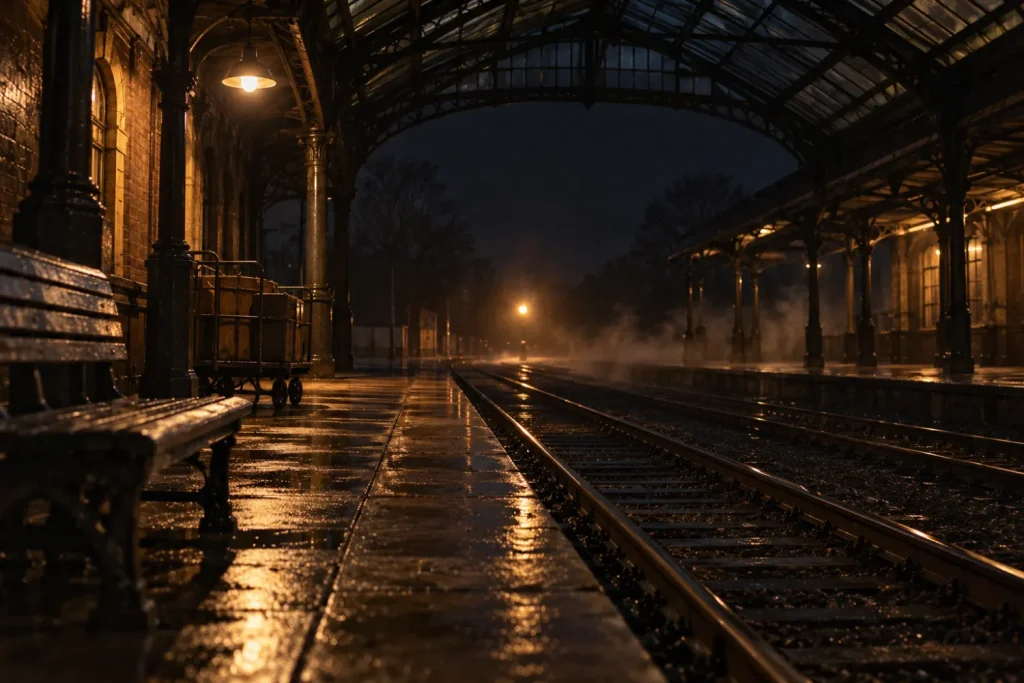
To see how the railway companies sold travel before him, with sunny landscapes rather than machines, read our article on PLM and SNCF railway posters.
An interlude at aperitif time
In 1932, Cassandre invented a three-part poster for the aperitif Dubonnet. In the first, a little man in a bowler hat looks at his glass, and we read “Dubo”; in the second, he drinks, colour spreads through his body, and the word becomes “Dubon”; in the third, he pours another, he is fully coloured, and the whole name appears: “Dubonnet”. A story in three pictures, readable from the window of a bus. The little man brought him the popularity his paintings never would.
Cassandre passed this idea on. He taught poster design in the 1930s, and his students included Raymond Savignac, Bernard Villemot and André François. Savignac kept the same rule of one idea per poster: we devote an article to him, Raymond Savignac, the master of the advertising poster.
At sea with the Normandie
For ocean liners, Cassandre had found his formula as early as 1928 with the Statendam, for the Holland America Line: the ship seen head-on and from below, like a monument. In 1935, the French Line entrusted him with the Normandie, the largest liner in the world, 313.75 metres long. He reduced it to a huge bow rising out of the sea, its funnels above, with a few tiny seagulls as the only sense of scale.
The ship sailed for only four seasons, from 1935 to 1939, before being stranded in New York by the war, then burning in the harbour in 1942. The poster, however, became the very image of Art Deco. ⚓ Its codes, symmetry, vertical lines and gradients, are the ones we explain in our article on Art Deco style.
Cassandre’s destinations
His trains and ships are what people remember. It is easy to forget that between 1928 and 1951 Cassandre also signed a series of travel posters. The chronological list of his work includes:
- Écosse (Scotland, 1928 and 1934)
- Côte d’Azur (1931)
- Angleterre (England, 1934)
- Italia (1935 and 1936)
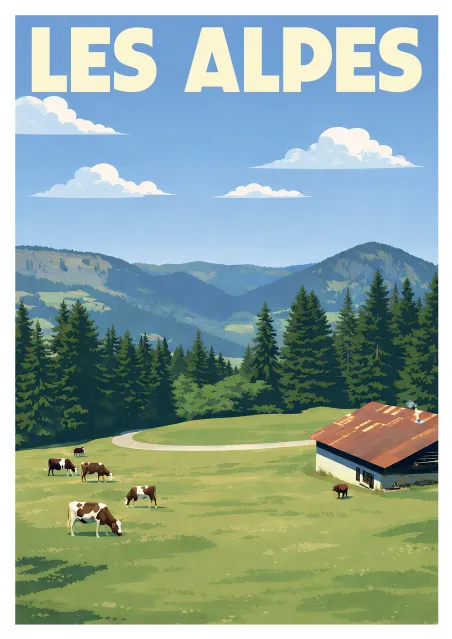
- Les Alpes (1935)
- Venise (Venice, 1951), one of his very last travel posters
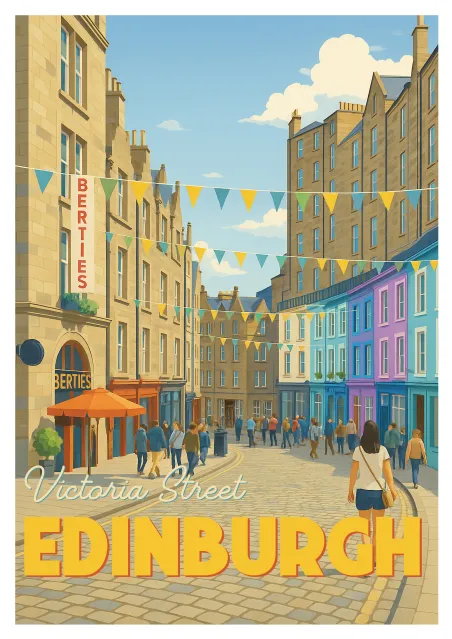
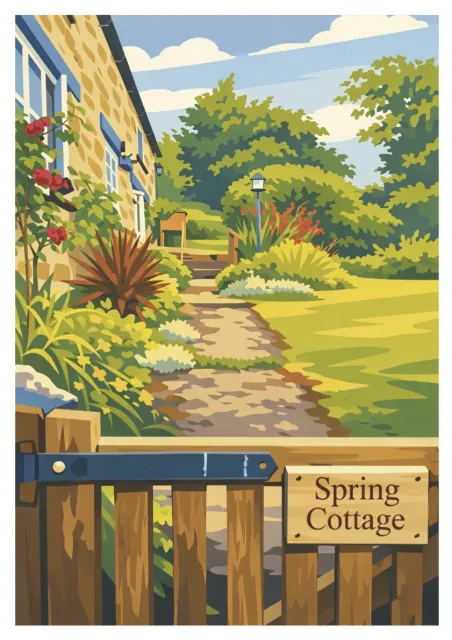
This travel map looks a lot like ours. With all due modesty, our posters come from the same tradition: a real place, reduced to a few shapes and a few flat colours, to make you wish you were there. Here are three of those destinations, as we drew them from our own travel photos:
Scotland, England and the Alps, our way
When lettering becomes the image
“A poster is not a painting,” Cassandre liked to say. For him, the poster artist plays the role of a telegraph operator: he does not give his opinion, he transmits a message, clear and readable from afar. Hence his passion for letters. He designed his own typefaces for the Deberny et Peignot foundry: Bifur (1929), with letters reduced to their essential stroke and filled out with fine hatching, Acier Noir and Peignot (1937). In 1961, brought out of retirement, he also drew the interlaced Yves Saint Laurent monogram, still in use today.
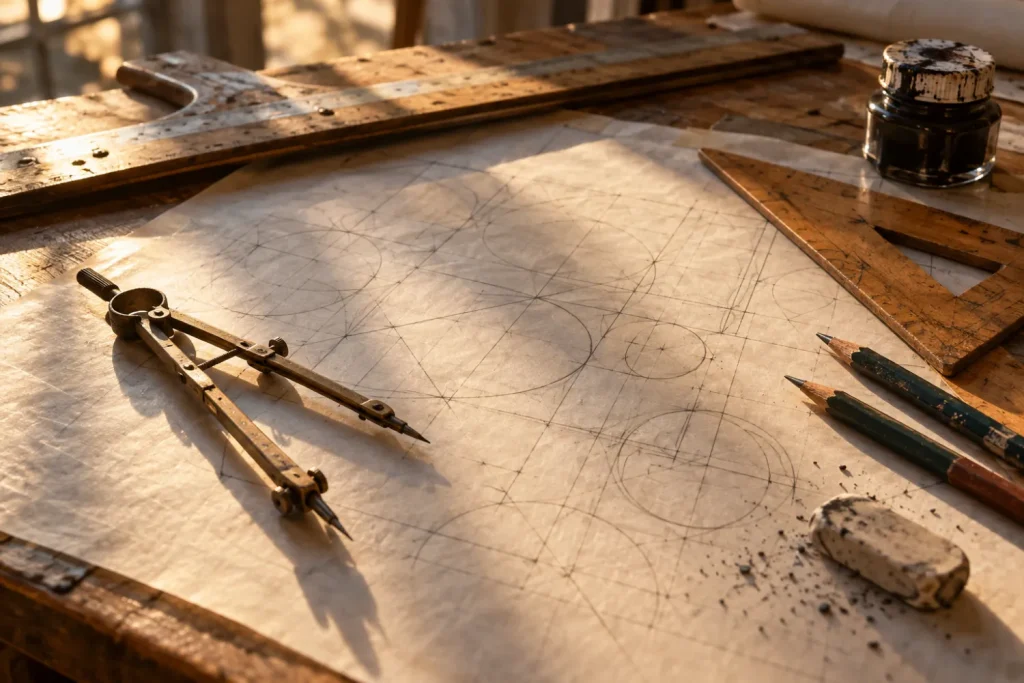
His posters, which seem to spring from a single stroke, are in fact built with compass and set square on a grid of modules. The spontaneity is an effect, not a method.
Frequently asked questions
Who was Cassandre?
Cassandre, born Adolphe Mouron (1901-1968), was a French poster artist, graphic designer, typographer and stage designer, born in Kharkov. A major figure of Art Deco, he created the posters Étoile du Nord, Nord Express, Dubonnet and Normandie, as well as the Yves Saint Laurent logo.
What is Cassandre’s most famous poster?
Normandie (1935), which shows the liner head-on like a cliff of steel, is the most reproduced. Specialists also point to Étoile du Nord and Nord Express (1927), which brought the French poster into the modern age.
Did Cassandre design an Orient Express poster?
No. No Orient Express poster appears in the list of his works. The confusion comes from Nord Express (1927), commissioned by the International Sleeping-Car Company, which also ran the Orient Express. Cassandre also signed Wagons-Lits Cook (1933) for the company.
Which typefaces did Cassandre design?
For the Deberny et Peignot foundry, he designed three typefaces: Bifur (1929), Acier Noir and Peignot (1937). Almost always in capitals and without serifs, they were designed for posters and to be read from a distance.
Where can you see Cassandre’s posters?
The Musée des Arts Décoratifs in Paris holds a large collection and gave him a retrospective as early as 1950. The Bibliothèque nationale de France also holds some, and original posters regularly come up at auction.
Evening on the lagoon
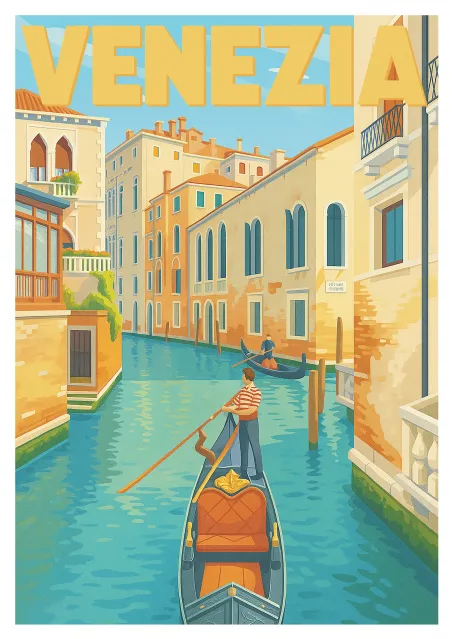
The Venice poster of 1951 looks like no other Cassandre. No speeding locomotive, no giant bow: a gondolier in profile, his reflection in the water, a palazzo in shadow and a fading sky. The man of speed ended up painting a still moment. It may be the gentlest of his posters, and proof that a place, looked at closely, is enough to make an image.
Find all our 1930s-style posters in our collections, and our Italian journeys in the Italy category.