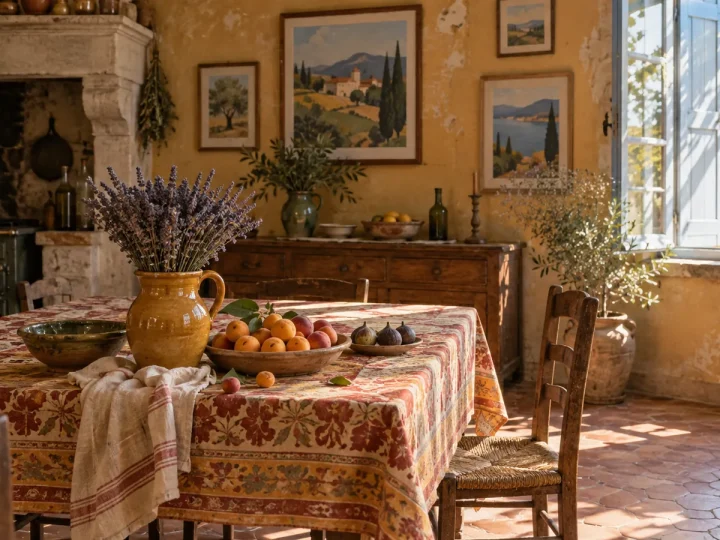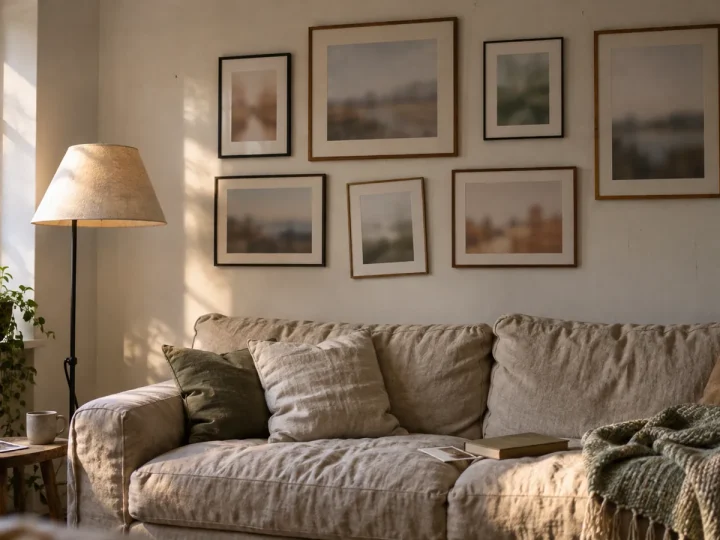
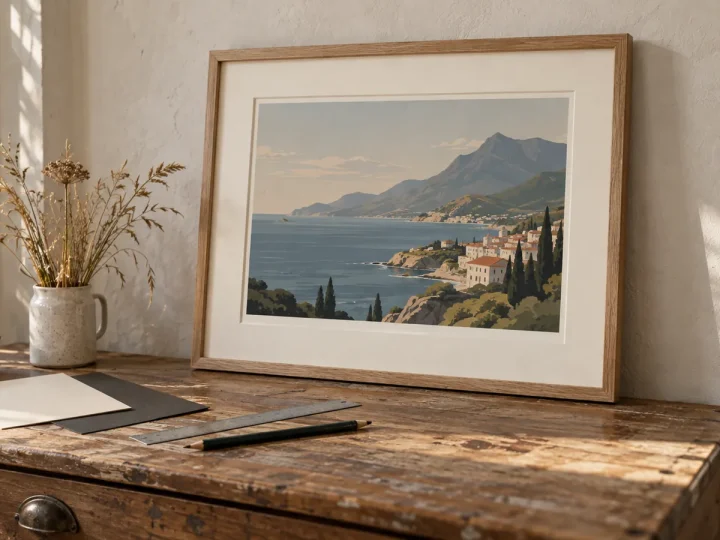
To choose the right picture mount size (a mat, in the US), start from your poster: the window should be 3 to 5 mm smaller than the image on each side, and the border should be about 5 cm at the very least. In practice, an A4 poster goes in a 30 x 40 cm frame, an A3 in a 40 x 50 or 50 x 70 cm frame.
What size mount for an A5, A4 or A3 poster?
Here are the combinations that work with the three sizes of our posters. The window is based on a 4 mm overlap on each side. Frames and mounts are sold in DIY stores, home decor shops and by picture framers.
| Poster | Mount window | Frame | Resulting border | The effect |
|---|---|---|---|---|
| A5 (14.8 x 21 cm) | 14 x 20.2 cm | 24 x 30 cm | 5 cm all round | Balanced, ideal on a shelf or in a gallery wall |
| A5 (14.8 x 21 cm) | 14 x 20.2 cm | 30 x 40 cm | 8 cm on the sides, 10 cm top and bottom | Gallery look: the small poster becomes a statement piece |
| A4 (21 x 29.7 cm) | 20.2 x 28.9 cm | 30 x 40 cm | 4.9 cm on the sides, 5.5 cm top and bottom | The classic, the easiest to find |
| A4 (21 x 29.7 cm) | 20.2 x 28.9 cm | 40 x 50 cm | 9.9 cm on the sides, 10.5 cm top and bottom | Very airy, above a console table or a bed |
| A3 (29.5 x 41.9 cm) | 28.7 x 41.1 cm | 40 x 50 cm | 5.6 cm on the sides, 4.5 cm top and bottom | Compact, but a little tight in height |
| A3 (29.5 x 41.9 cm) | 28.7 x 41.1 cm | 50 x 70 cm | 10.6 cm on the sides, 14.5 cm top and bottom | Large format, for a living room or above a sofa |
Our A3 measures 29.5 x 41.9 cm, just under the standard A3 (29.7 x 42 cm), so a mount sold “for A3” fits it perfectly.
A small A5 poster, ideal in a 24 x 30 cm frame

How do you measure a picture mount?
Three measurements are enough: the poster, the window and the frame. On the outside, the mount is always the size of the inside of the frame (the size of the glass). 📏
- Measure your poster, width and height, to the millimetre.
- Work out the window: take 6 to 10 mm off each dimension, which means 3 to 5 mm of overlap on each side. The mount then covers the edge of the poster and holds it in place.
- Choose a border: about 5 cm at the very least, and between 5 and 10 cm for most posters. Below 4 cm, the mount looks like a mere edging.
- Work out the frame: window + twice the border, then round to the nearest standard frame size (24 x 30, 30 x 40, 40 x 50, 50 x 70 cm).
- Check the balance: the bottom border should be equal to or slightly wider than the top one, never narrower. The eye sees a perfectly centred image as sitting a little too low.
The formula: border = (frame dimension – window dimension) / 2. For an A4 poster in a 30 x 40 cm frame, with a 20.2 x 28.9 cm window: (30 – 20.2) / 2 = 4.9 cm on the sides, and (40 – 28.9) / 2 = 5.5 cm at the top and bottom.
What a mount actually does
The mount is the cut card that surrounds the image inside the frame. It does three jobs:
- It shows the image off: the border gives the poster room to breathe and draws the eye to it. A small poster in a large frame instantly gains presence.
- It protects the image: it keeps it away from the glass, so it does not stick to it or pick up marks from moisture.
- It fits a poster to a standard frame: it bridges the gap between the size of the image and the size of the frame you found.
Its inner opening, called the window, is cut with a 45° bevel: this small sloping edge reveals the white core of the board and draws a thin line of light around the image.
White, cream or black mount: which colour should you choose?
The colour of the mount matters as much as its size. It should serve the image, not compete with it.
| Colour | With which posters | The effect |
|---|---|---|
| Off-white, ivory or cream | Vintage-style posters with warm colours and flat areas of colour | Soft and natural, it recalls old paper. Our choice for most of our posters |
| Bright white | Very bright images, in a modern interior | Crisp and contrasted, but it can make vintage colours look a little dull |
| Black or charcoal grey | Night scenes, northern lights, graphic interiors | Striking, it makes bright colours stand out |
| A colour taken from the poster | A poster dominated by one shade (the blue of a lake, the pink of granite) | Original, best kept for a single frame or a thin line |
For a double mount, two boards are layered: the first, in off-white, makes the border, and the second, in a colour taken from the poster, shows 3 to 5 mm around the image. This thin coloured line frames the illustration without weighing it down. ✨
The blue of a lake and the pink of granite: two colours for a thin line


How do you choose a frame sold with its mount?
Many frames come with a pre-cut mount. Before buying, check the size of the window, not just the size on the label: a 21 x 29.7 cm window, exactly the size of an A4 sheet, lets the poster slip through instead of holding it. You need a window slightly smaller than the image, around 20 x 28.5 cm for an A4.
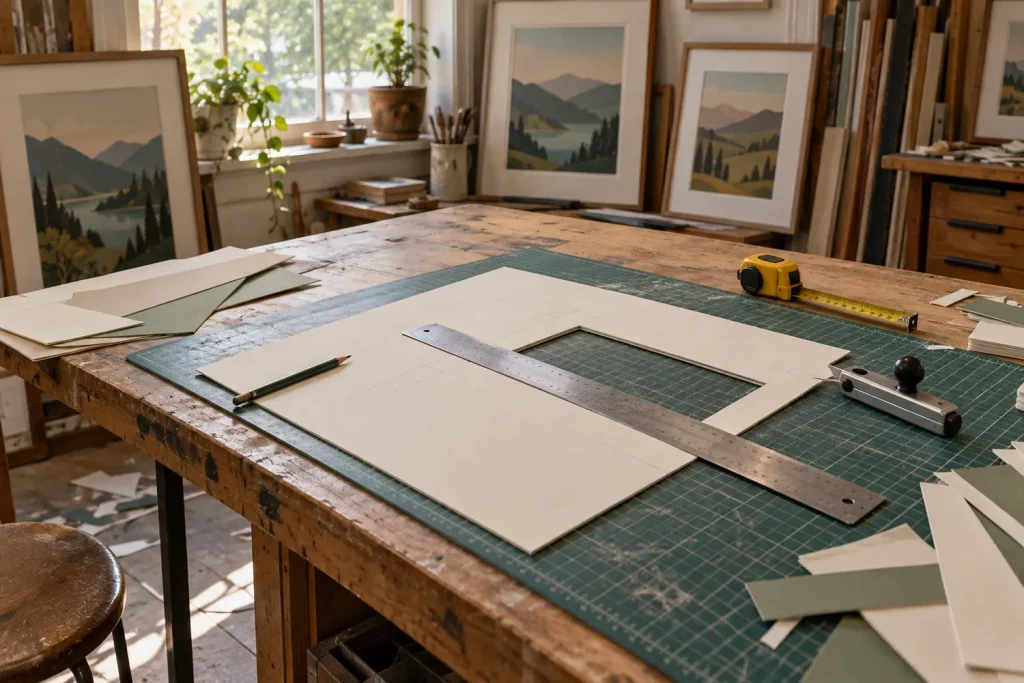
If the window does not match, a picture framer can cut a made-to-measure mount, or you can cut one yourself with a bevel mount cutter, a steel ruler and a little patience.
Should you always use a mount?
No. A poster can also be framed edge to edge, in a frame exactly its size: 15 x 21 cm for an A5, 21 x 29.7 cm for an A4, 30 x 42 cm for an A3. The result is more graphic and direct, and takes up less wall space.
- With a mount: for a single poster you want to show off, a small poster in a large frame, or a gallery that needs a sense of unity.
- Without a mount: for a wall that is already busy, a shelf, a tight grid of identical frames, or when the illustration already fills the whole sheet.
In a gallery wall, choose a single mount colour for the whole arrangement: it is what ties together posters of different sizes and places.
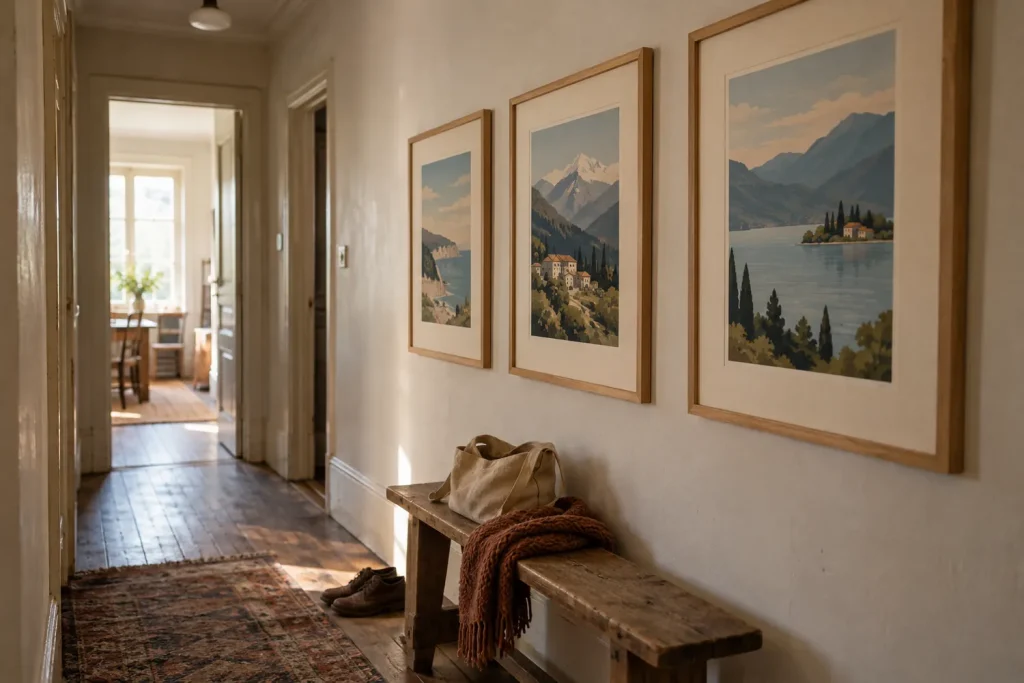
Posters to frame
All our posters lend themselves to it, in A5 (€15), A4 (€19) or A3 (€24). Landscapes in flat colours, with a sky or water filling much of the image, look especially good with room to breathe in an off-white border.
In A4, in a 30 x 40 cm frame
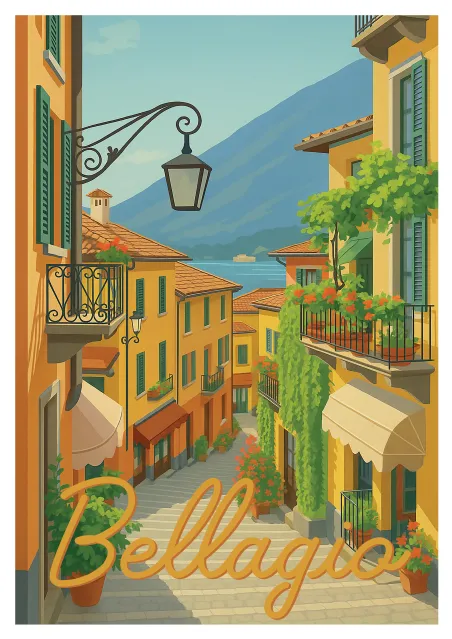
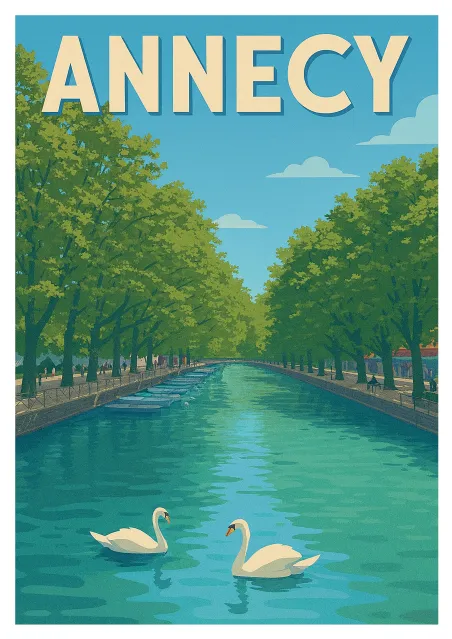
In A3, in a 50 x 70 cm frame above a sofa

Once the frame is ready, follow our guide on how to hang a picture frame at the right height, with the centre of the image about 1.50 m from the floor.
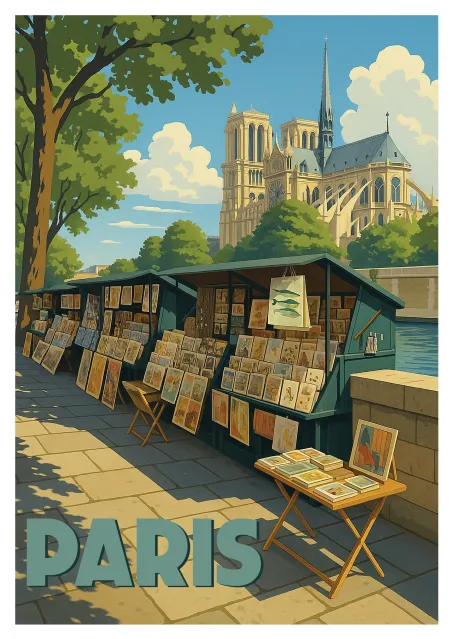
A well-chosen mount turns a poster from a simple image into a small framed artwork. Measure, keep a border of about 5 cm at the very least, and prefer off-white for vintage colours. To go further, build a gallery with our gallery wall ideas, and browse our travel posters by destination to find the ones that deserve their mount.
More posters to frame


Frequently asked questions
What size mount for an A4 poster?
For an A4 poster (21 x 29.7 cm), use a 30 x 40 cm frame and a mount with a window of about 20.2 x 28.9 cm. The border is then about 5 cm. For a more airy look, go up to a 40 x 50 cm frame, with a border of about 10 cm.
What frame for an A3 poster with a mount?
A 40 x 50 cm frame gives a border of 4.5 to 5.6 cm, a little tight in height. A 50 x 70 cm frame gives a border of 10.6 cm on the sides and 14.5 cm at the top and bottom, which looks more elegant above a sofa or a bed.
How wide should a mount border be?
About 5 cm at the very least, and usually between 5 and 10 cm. The smaller the poster, the more a wide border shows it off. The bottom border should be equal to or slightly wider than the top one.
How much smaller than the poster should the window be?
By 3 to 5 mm on each side, which means 6 to 10 mm in width and in height. The mount then covers the edge of the poster and holds it in place without hiding the illustration.
White or black mount?
For a vintage-style poster, off-white or cream is the safest choice: it suits warm colours. Black works with dark or very colourful images and graphic interiors. Bright white suits bright images and modern interiors.