The Art Nouveau poster was born in Paris in the 1890s, and Alphonse Mucha became its greatest master. On 1 January 1895, his poster Gismonda for Sarah Bernhardt covered the walls of the city: haloed women, hair swirling into arabesques, flowers and mosaic ornaments. Within a few months, his style had become the style of an entire era.
Here is who Mucha was, how to recognise his style, 6 of his works worth knowing, the other great Art Nouveau poster artists, and how to bring that spirit into your home.
Who was Alphonse Mucha?
- His origins: Alfons Mucha (Alphonse in French) was born on 24 July 1860 in Ivančice, Moravia, in today’s Czech Republic.
- His training: a theatre set painter in Vienna, then a student at the Munich Academy, he arrived in Paris in 1887 and attended the Académie Julian and the Académie Colarossi.
- His early years in Paris: he earned his living illustrating books, catalogues and calendars, notably for the publisher Armand Colin.
- Fame: the Gismonda poster (1894) made him famous overnight. He won a silver medal at the 1900 Paris World’s Fair.
- Back home: after a stay in the United States from 1906 to 1910, he returned to Prague, painted The Slav Epic until 1928 and designed the first stamps and banknotes of Czechoslovakia. He died in Prague on 14 July 1939.
How did the Gismonda poster launch Mucha?
On 24 December 1894, Sarah Bernhardt, the greatest actress of her time, asked the Lemercier printing house for a poster for Gismonda, the Victorien Sardou play she was performing at the Théâtre de la Renaissance. It was Christmas Eve, and Mucha was the only artist available. He took up the challenge. 🎭
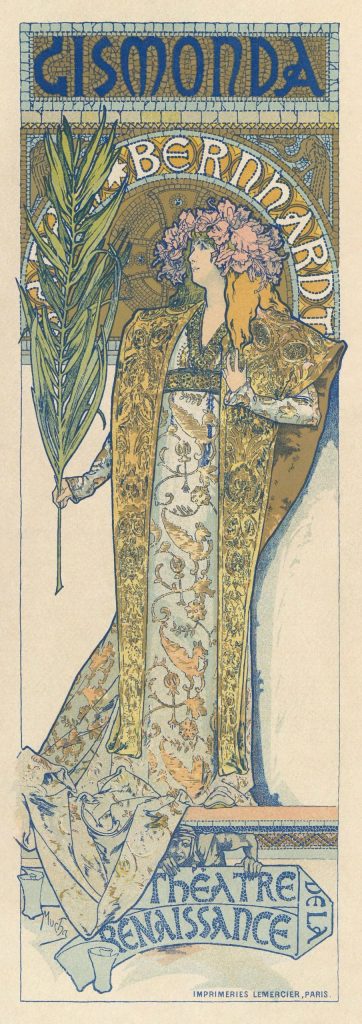
On the morning of 1 January 1895, his posters covered the walls of Paris. Their format was striking: 74.2 cm wide and 2.16 m tall, with the actress shown almost life-size in a gold-embroidered Byzantine gown, holding a palm frond. They were such a hit that collectors cut them off the walls to take them home. Sarah Bernhardt immediately signed him to a six-year contract.
How do you recognise the Mucha style?
| Design feature | What you see | Example |
|---|---|---|
| A woman at the centre | A young woman, often in profile or three-quarter view, fills the whole poster | Job, The Seasons |
| Arabesque hair | Long locks that curl and become a decorative pattern | Job |
| The halo | A circle or an arch behind the head, like an icon | Gismonda, Monaco Monte-Carlo |
| Flowers | Crowns, garlands and branches frame the figure | The Seasons, Monaco Monte-Carlo |
| Mosaic and stained glass | Backgrounds and borders cut into small patterns, outlined in a line | Gismonda |
| Soft colours | Pastels, ochres and touches of gold rather than bright colours | The Seasons |
| Hand-drawn lettering | The title is part of the design, in ornamental letters | Gismonda, Job |
In 1902, Mucha gathered his patterns in Documents décoratifs, a collection of 72 ornamental drawings. By then his style had gone well beyond the poster: in 1901, he even designed an entire jewellery shop, for the jeweller Georges Fouquet on rue Royale in Paris.
6 Mucha posters worth knowing
Gismonda (1894)
The first and the most famous. Its very narrow format, almost that of a door, and the solemn pose of Sarah Bernhardt, haloed by a mosaic arch, make it an image you do not forget.
La Dame aux camélias (1896)
For the play by Alexandre Dumas fils, revived by Sarah Bernhardt at the Théâtre de la Renaissance, Mucha kept the same tall vertical format. More posters for the actress followed, including Lorenzaccio (1896), Médée and Hamlet.
Job (1896)
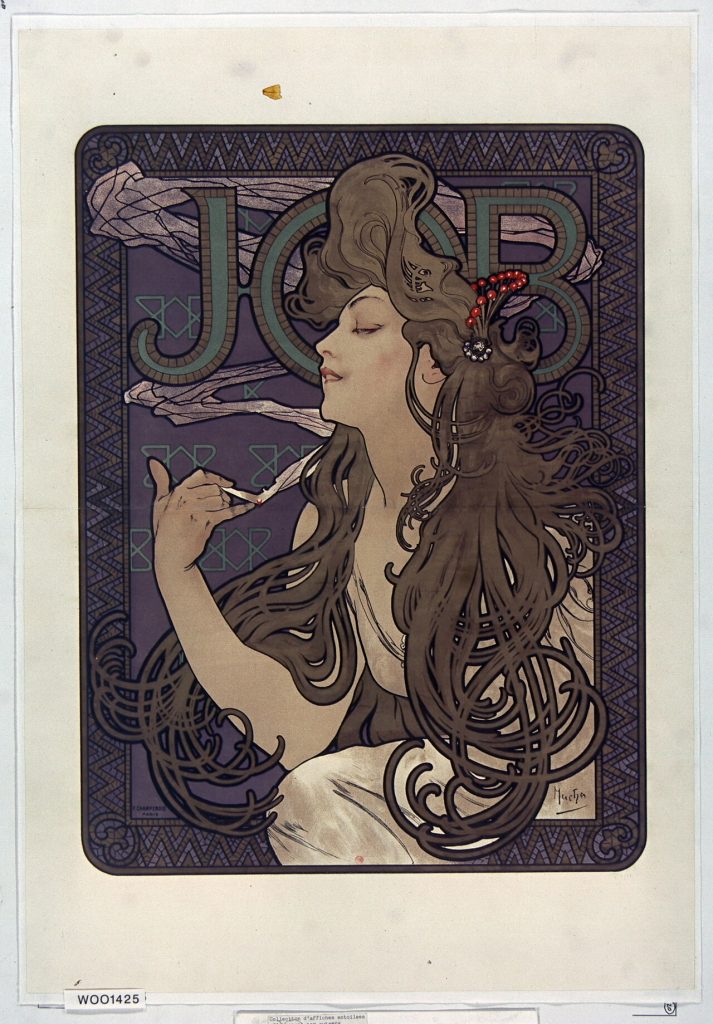
An advertisement for a brand of cigarette paper, it shows a young woman with half-closed eyes, whose huge mane of hair spills out of the frame and curls into scrolls. The letters JOB, in mosaic, repeat in the background. It is the very image of the Mucha style.
The Seasons (1896)
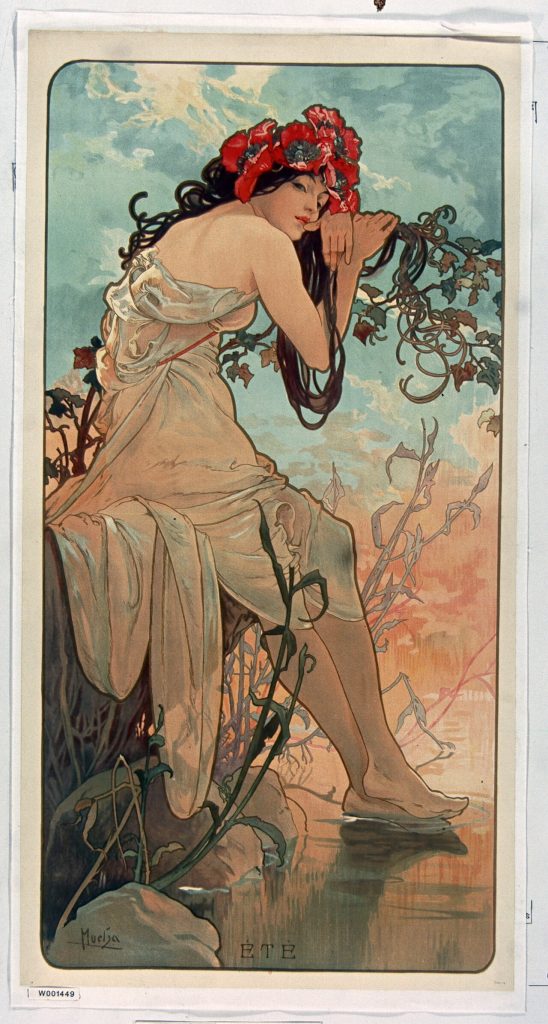
More than a poster, this is a decorative panel: a series of four lithographs with no advertising text, made to be framed. Spring, Summer, Autumn and Winter take the shape of four young women in a landscape. Summer, crowned with poppies, dips her feet in the water. Building on this success, Mucha went on to create more series of decorative panels: The Arts (1898), The Flowers (1898), The Times of the Day (1899) and The Precious Stones (1900). 🌸
Monaco Monte-Carlo (1897)
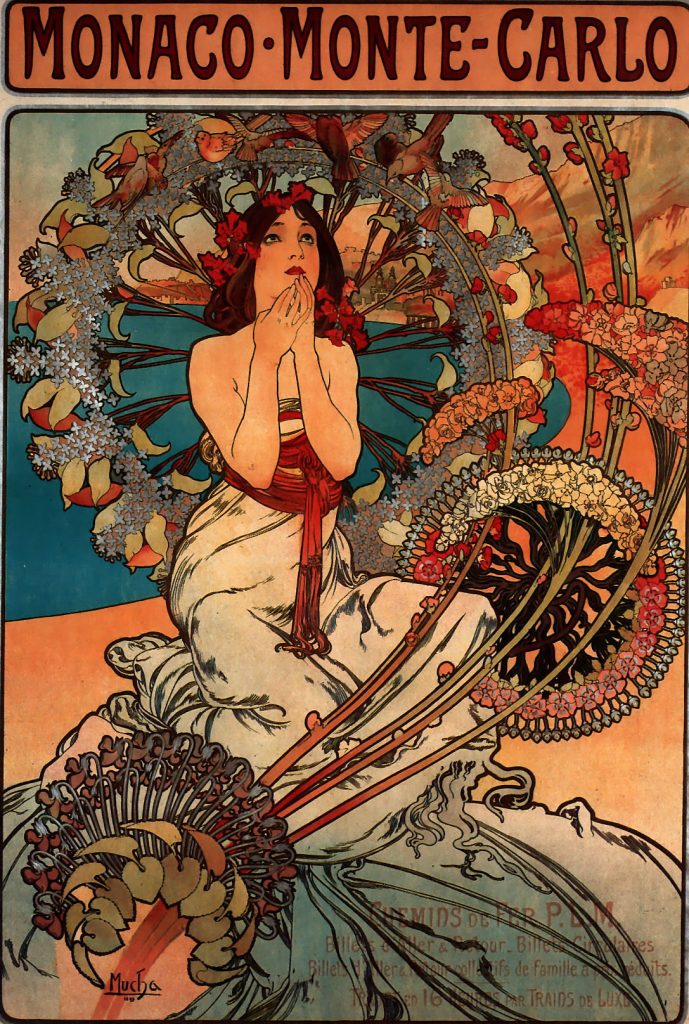
A young woman kneels with her hands clasped, surrounded by large wheels of flowers, with the sea and the mountains behind her. Commissioned by the PLM railway company, this poster links Art Nouveau with travel posters, whose golden age we tell in our article on PLM and SNCF railway posters.
The Times of the Day (1899)
Four narrow panels, each 39 cm by 107.7 cm: Morning Awakening, Brightness of Day, Evening Reverie and Night’s Rest. Once again, a series designed to decorate a wall, which reads from left to right like a day.
Who were the other Art Nouveau poster artists?
| Poster artist | Dates | Key facts |
|---|---|---|
| Jules Chéret | 1836-1932 | Known as the father of the Belle Époque poster, he brought the colour illustrated poster to the streets of Paris |
| Eugène Grasset | 1845-1917 | Engraver, poster artist and decorator, he turned his hand to everything: stained glass, jewellery, furniture, illustration |
| Théophile-Alexandre Steinlen | 1859-1923 | The poster for the Tournée du Chat Noir and the cats of Montmartre |
| Henri de Toulouse-Lautrec | 1864-1901 | Posters for the Moulin Rouge and the cabarets, in bold flat colours |
| Henri Privat-Livemont | 1861-1936 | One of the great Belgian masters of the illustrated poster |
Steinlen and Toulouse-Lautrec made Montmartre, then the district of artists and cabarets, the setting of their posters. The works of these five poster artists are now in the public domain.
What is the difference between Art Nouveau and Art Deco?
| Art Nouveau | Art Deco | |
|---|---|---|
| Period | From the 1890s to the eve of the First World War, peaking around 1905 | From the 1910s to the 1940s |
| Lines | Curves, arabesques, “whiplash” lines | Geometry, symmetry, straight lines |
| Motifs | Flowers, vines, hair, insects | Stylised shapes, sunbursts, zigzags, speed |
| Colours | Soft, pastel, touches of gold | Bold, contrasting, black and gold |
| Poster artists | Mucha, Grasset, Privat-Livemont | Cassandre, Roger Broders, Paul Colin |
The very name Art Nouveau comes from a shop: the Maison de l’Art Nouveau, opened in Paris by the art dealer Siegfried Bing on 26 December 1895. Its critics in France nicknamed it the “noodle style”, because of its swirling shapes. For the next chapter of the story, read our article on the Art Deco style.
Where can you see Mucha’s work?
- The Mucha Museum in Prague, housed in the Kaunický Palace, a baroque palace in the New Town, and dedicated to the artist.
- The Musée Carnavalet in Paris, which displays the Fouquet jewellery shop Mucha designed in 1901 for 6 rue Royale, dismantled in 1923 and later rebuilt in the museum.
- Gallica, the digital library of the Bibliothèque nationale de France, where many of Mucha’s posters can be viewed for free in high definition.
- Major exhibitions: the Musée du Luxembourg in Paris held a retrospective from September 2018 to January 2019, and the Grand Palais Immersif an exhibition in 2023.
How do you bring the Art Nouveau spirit into your home?
Hang them as a series
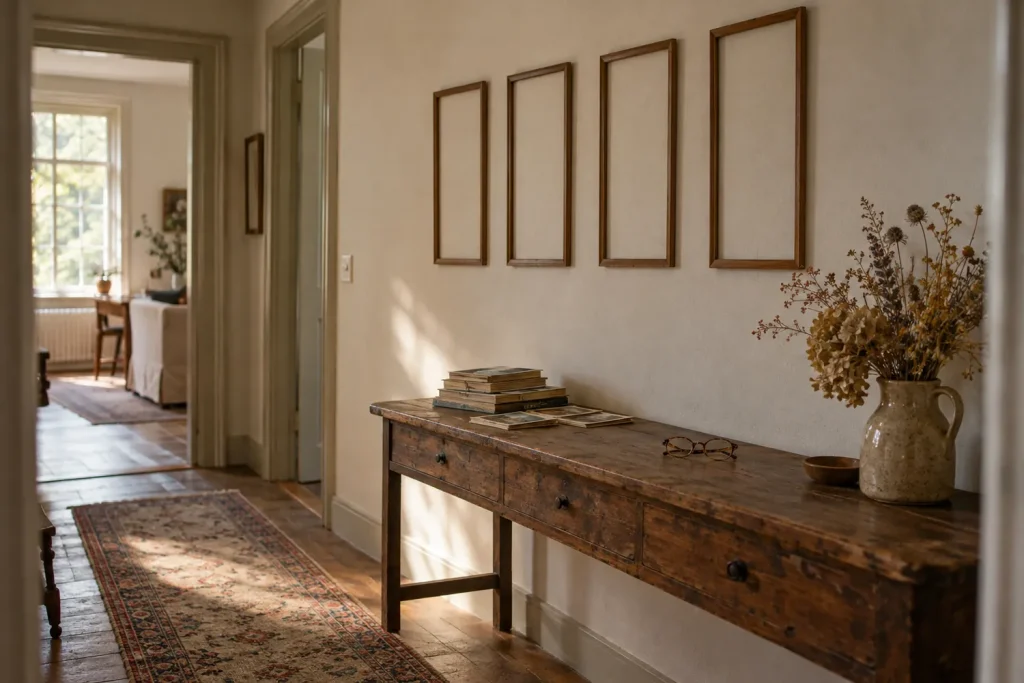
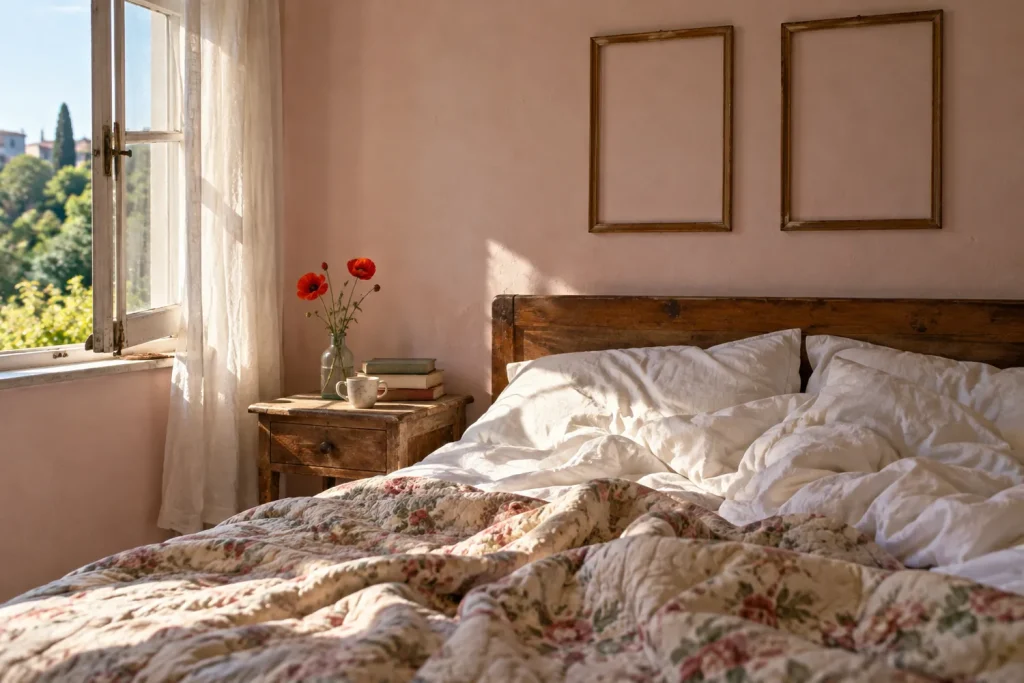
Mucha designed his panels in fours: four seasons, four times of the day, four flowers. Borrow the idea with three or four posters of the same size, hung at the same height in a hallway or above a bed. Our gallery wall guide will help you plan the arrangement, and our article on how to hang a picture frame will help you find the right height.
Choose thin frames and soft tones
Mucha’s posters do not sit well in thick frames or next to loud colours. Go for a thin frame in natural or gilded wood, a light wall (cream, sage green, dusty pink), and a few dried flowers or a seasonal bouquet nearby to echo the floral motifs.
Go back to Paris in 1900
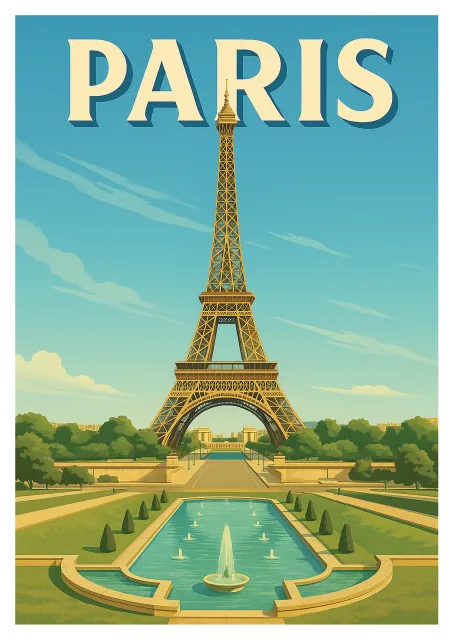
Art Nouveau was born in Belle Époque Paris, the Paris of the Eiffel Tower built for the 1889 World’s Fair, the Montmartre cabarets and the bookstalls along the Seine. On a day in Paris, we could not resist having portraits of our children done by an artist in Montmartre, before strolling along the Seine from one bookstall to the next as far as Notre-Dame: we tell the story in our day in Paris with children on Rolling Trippers.
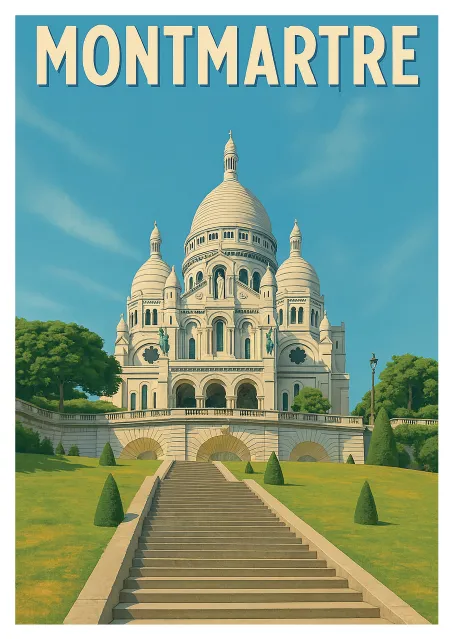
Our Paris posters do not copy Mucha: they were born from our own photos, in the style of 1930s travel posters. But they share with his panels the same wish to decorate a wall with a memory, and they go very well with an Art Nouveau print in the same arrangement.
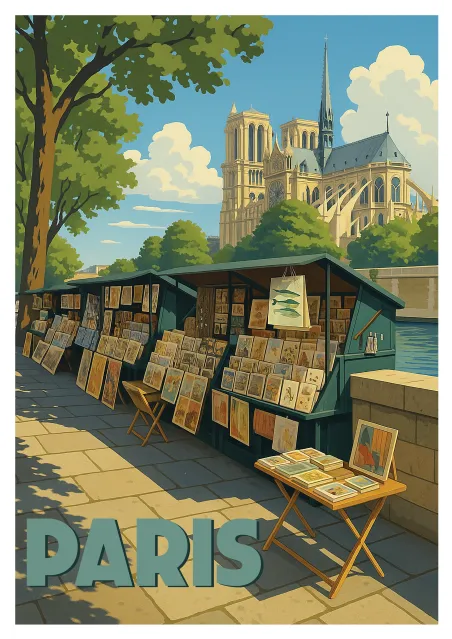
Our Paris posters, from the Belle Époque to today
Frequently asked questions
Who was Alphonse Mucha?
Alphonse Mucha (Alfons Mucha in Czech, 1860-1939) was a poster artist, illustrator and painter born in Moravia. He settled in Paris in 1887, became famous in 1895 with the Gismonda poster for Sarah Bernhardt, and remains the greatest name in Art Nouveau posters.
What is Mucha’s most famous poster?
Gismonda, created at the end of 1894 for Sarah Bernhardt and posted in Paris on 1 January 1895, is his most famous poster. It measures 74.2 cm by 2.16 m. Job (1896) and The Seasons series (1896) are also among his most reproduced works.
Are Mucha’s works in the public domain?
In France, a work enters the public domain 70 years after its author’s death, on the following 1 January. Since Alphonse Mucha died in 1939, his works have been in the public domain since 1 January 2010. A recent photograph or reproduction may, however, carry its own rights.
How do you recognise an Art Nouveau poster?
An Art Nouveau poster can be recognised by its curved lines, its flower and vine motifs, its female figures with long flowing hair, its soft colours and its decorative lettering built into the image. Most date from the 1890s to the 1910s.
Where can you buy a Mucha print?
As Mucha’s works are in the public domain, prints can be found in museum shops, at bookstalls and from many publishers. For good quality, choose a print made from a high-definition scan, such as those of the Bibliothèque nationale de France.
More than a century of beauty on the wall
With his posters, Mucha took art into the street, and with his decorative panels, he brought it into people’s homes. More than a century later, his panels have not aged a day. To keep exploring, read our other articles on poster art, and browse our France posters to put together your own series.