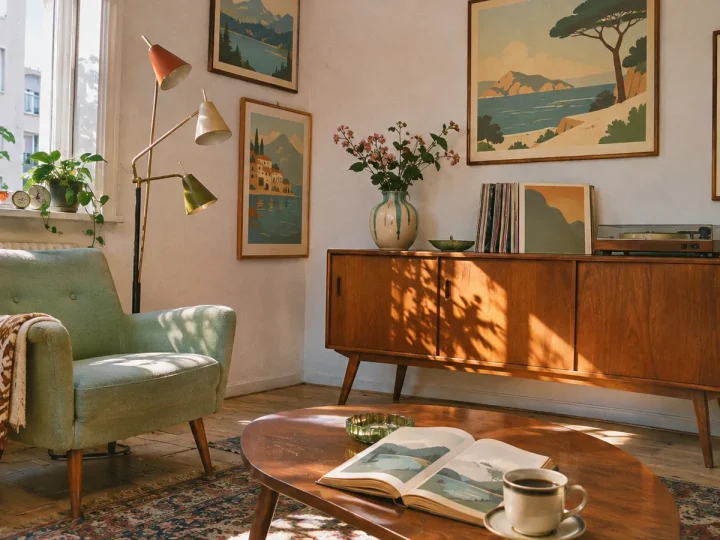
For 1950s decor, combine one piece of furniture on tapered splayed legs (a sideboard, table or armchair), a palette of pastels lifted by one bright colour, rounded shapes, materials of the time (teak, blond oak, Formica, rattan, lacquered metal) and a poster with flat graphic colours. One or two strong pieces are enough, mixed with today’s furniture.
The 1950s were the years of post-war reconstruction and the start of a long economic boom. People dreamed of modern comfort, queued at the Salon des Arts Ménagers in Paris, covered their kitchens in Formica, and homes that had been dark opened up to colour and light. American and Scandinavian designers invented light, organic shapes that are still recognisable at a glance. It is that mix of optimism and simplicity that is coming back today.
What furniture for a 1950s interior?
The surest sign of the 1950s is tapered splayed legs: thin, slightly angled, they lift sideboards, coffee tables and armchairs and make all the furniture look lighter. Add a kidney-shaped coffee table, a cocktail armchair with rounded arms, a trolley on castors or a perforated metal magazine rack, the signature of Mathieu Matégot.
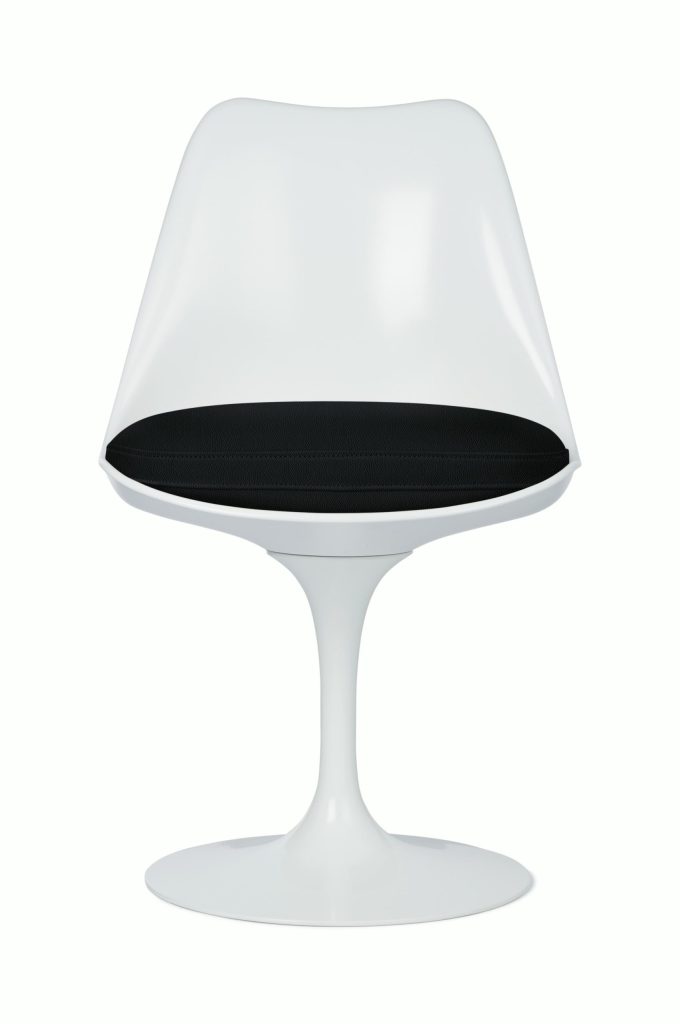
As for chairs, the decade left icons that are still produced: Charles and Ray Eames’s Plastic Chair (1950), Arne Jacobsen’s Ant chair (1952), Harry Bertoia’s steel-wire Diamond chair (1952). And Eero Saarinen’s Tulip, designed in 1957 to clear up what he called the “slum of legs” under tables: a single central pedestal, like a flower stem.
What colours for 1950s decor?
The fifties palette combines soft pastels and bright accents. Pastels cover large surfaces (walls, kitchen, textiles), bright colours are kept for details (a chair, a lamp, a poster). Blond wood or teak links the two. 🎨
| The colour | Where to use it | What with |
|---|---|---|
| Eau de nil, mint green | Kitchen walls, armchair, painted dresser | Blond wood, off-white, touches of red |
| Sugared-almond pink | Bedroom, bathroom, cushions | Light grey, graphic black, brass |
| Primrose yellow | Kitchen, chairs, curtains | Sky blue, white, Formica |
| Sky blue | Bedroom walls, bed linen | Yellow, cherry red, teak |
| Cherry red, turquoise, mustard | A chair, a lamp, a poster | Always as an accent, on a light background |
Which patterns?
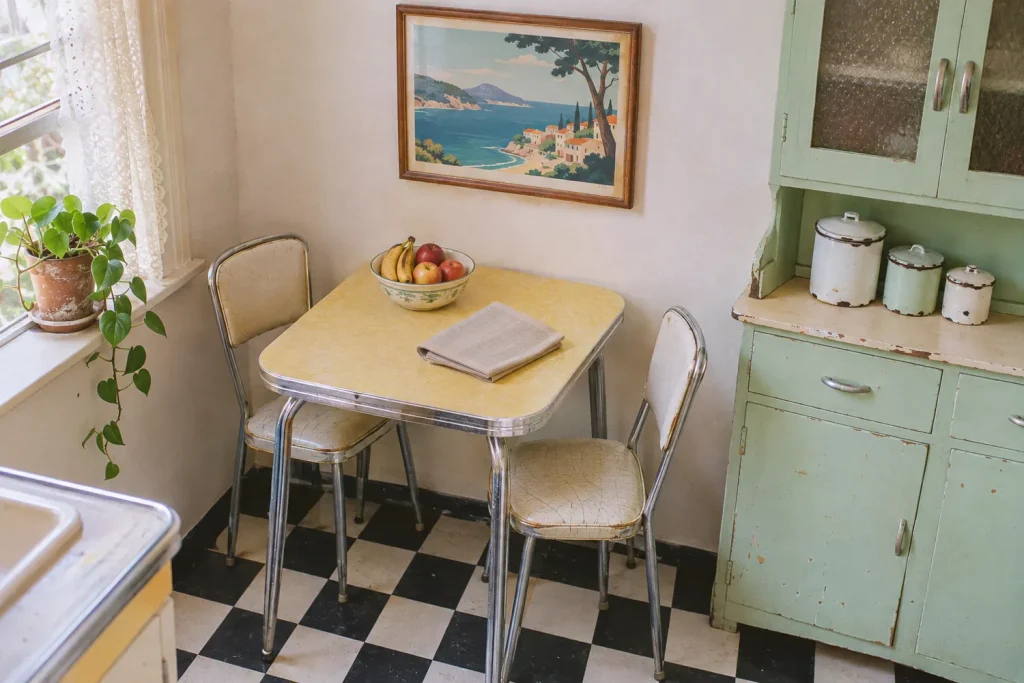
The 1950s loved patterns inspired by science and movement: atomic shapes (balls joined by rods), boomerangs, stars, small diamonds and free-form shapes on fabrics and Formica. On the floor, the black and white checkerboard of kitchens and American diners. A single pattern per room, on a curtain, wallpaper or a tray, is enough to set the tone.
Which materials?
Teak and blond oak for furniture, Formica for worktops and kitchen tables, rattan and wicker for light armchairs, lacquered metal for legs and lamps, a touch of brass. And ceramics: free-form vases with colourful glazes, like those from Vallauris, where Picasso worked with clay from 1948, are the perfect ornament for a 1950s sideboard.
What lighting?
1950s lights are recognisable by their arms: three-branch floor lamps, articulated wall lights like those of Serge Mouille, counterweight pendants. Their shades in lacquered metal or fabric, often cone-shaped, direct the light rather than diffuse it. Just one of these lamps, above an armchair or a table, defines the room.
What to hang on the walls?
This was the golden age of the graphic poster. In 1949, Raymond Savignac created the Monsavon poster, with its cow whose milk flows into the soap: one idea, a simple drawing, flat colours. Tourism and airline posters were selling Italy, the Riviera and sunny holidays with the same economy of means. His career is told in our portrait of Raymond Savignac.
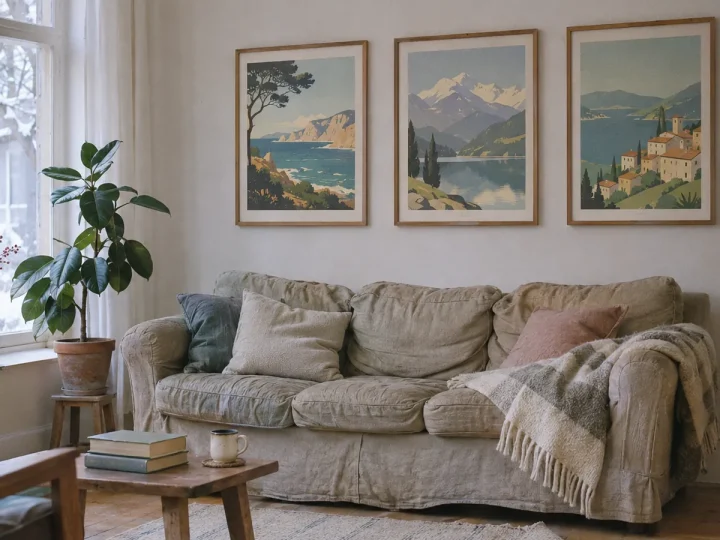
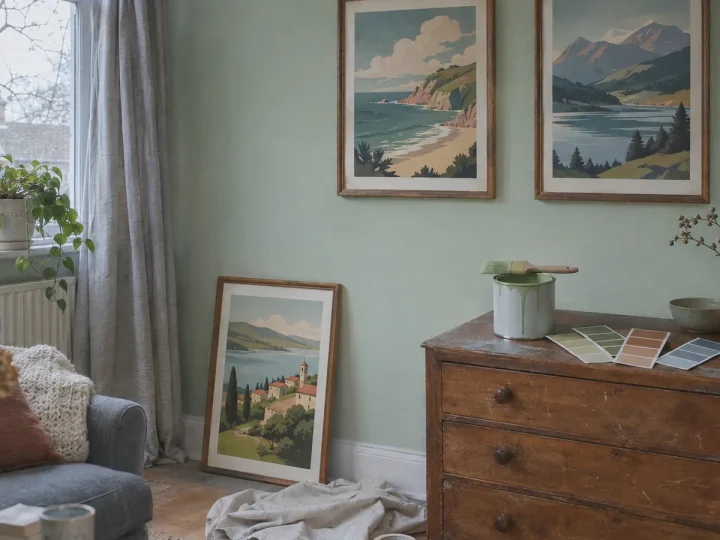
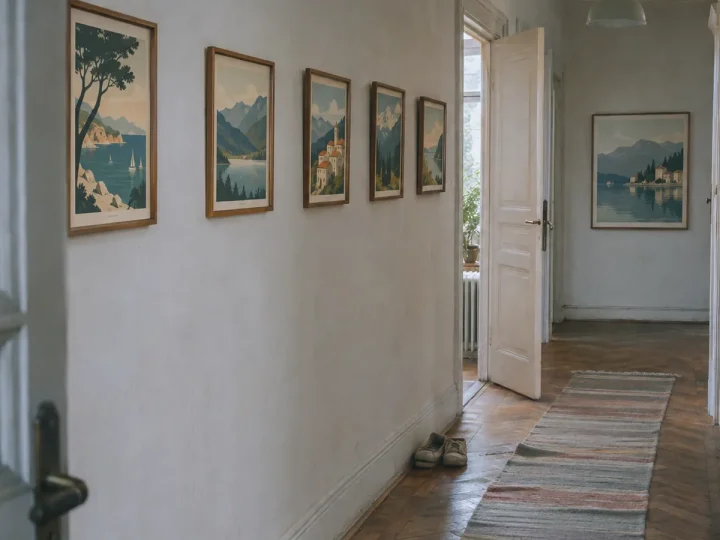
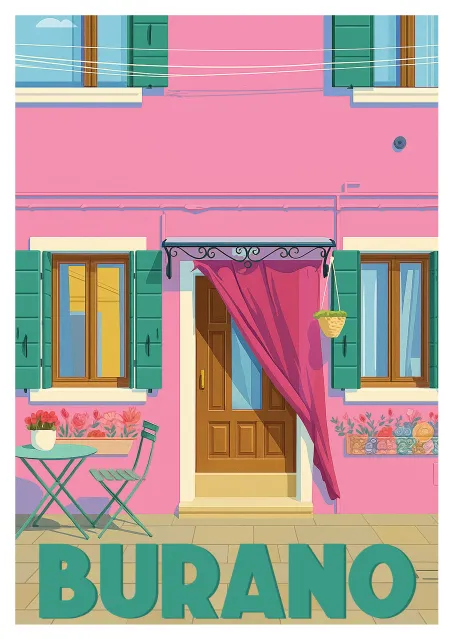
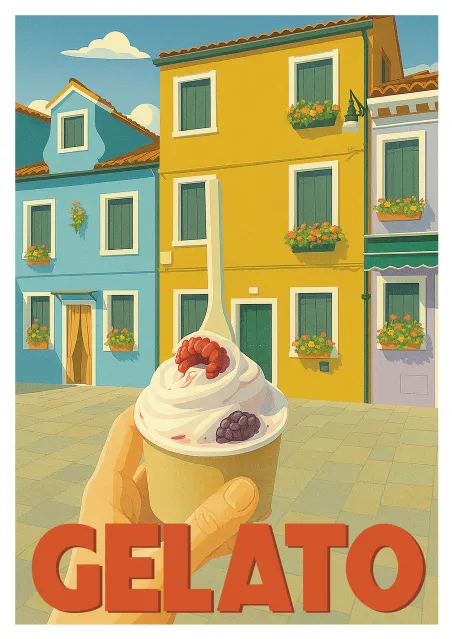
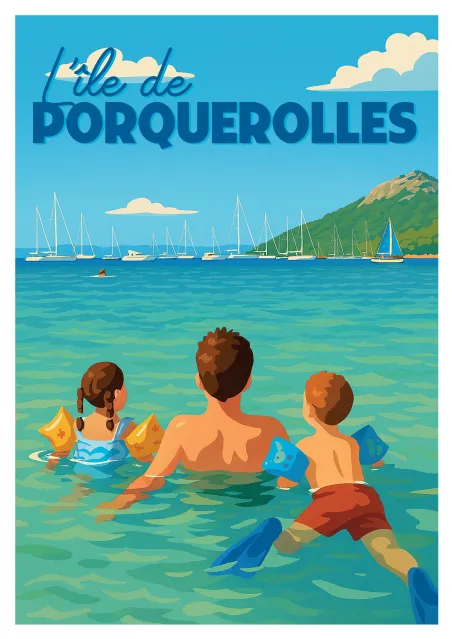
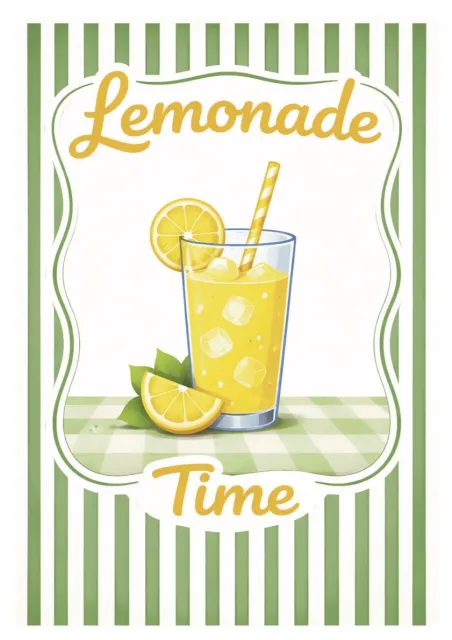
To capture that spirit without hunting for an expensive original, choose a poster with flat pastel colours and simple shapes, a sunny place that recalls the first summer holidays. Our posters are inspired precisely by European travel posters from the 1930s to the 1950s. In a slim blond wood or lacquered metal frame, above a sideboard, they tie in with the furniture. ☀️
Holiday pastels for a 1950s wall
Where to find 1950s furniture and objects?
Flea markets, car boot sales, charity shops and reuse centres are still the best places to find a sideboard, a trolley or a set of tableware at a low price. Classified ad sites let you search for something specific (“splayed legs”, “Formica”, “cocktail chair”). For signed pieces, try big flea markets such as Saint-Ouen near Paris and specialist galleries, with a budget to match. And many iconic designs are still produced new, under licence.
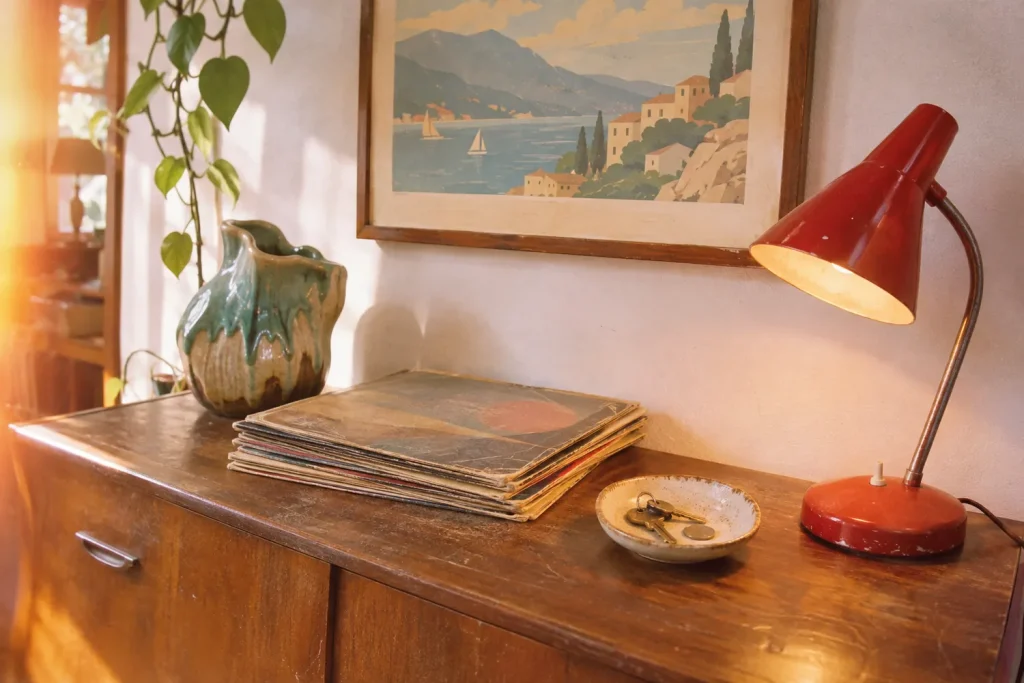
How to do 1950s style without living in a museum?
- One or two strong pieces per room: a sideboard on splayed legs, an arm lamp, then contemporary furniture around them.
- A palette, not a rainbow: one main pastel, one bright accent, wood to link them.
- A single pattern: atomic on a curtain, checkerboard on the floor or free-form shapes on a cushion, but not all three.
- Objects you use: colourful tableware, a trolley, a vintage radio rather than a cabinet of ornaments.
- A graphic wall: one or two posters in flat colours, which bring in the era without a single antique.
The 1950s pair very well with Scandinavian style, which shares their blond wood and simple shapes (see our cosy Scandinavian decor), and with the café spirit of bistro decor. Not to be confused with Art Deco style, which is older (1920s and 1930s), more geometric and more gilded.
Frequently asked questions
What are the features of 1950s decor?
Light furniture on tapered splayed legs, rounded organic shapes (kidney table, cocktail armchair), a palette of pastels (mint green, pink, yellow, sky blue) lifted by red or turquoise, materials such as teak, Formica, rattan and lacquered metal, and atomic or checkerboard patterns.
What colours for 1950s decor?
Pastels for large surfaces: eau de nil, sugared-almond pink, primrose yellow, sky blue. Bright colours as accents: cherry red, turquoise, mustard. Blond wood or teak links it all, and black and white adds a graphic touch, on the floor or in a pattern.
How do you create a 1950s vintage bedroom?
Choose a rounded or rattan headboard, a bedside table on splayed legs, a lamp with a cone shade and bed linen in a soft pastel, pink or sky blue. Add a poster in gentle colours above the bed, in a slim frame. The mood should stay calm: one bright accent is enough.
What is the difference between 1950s style and Art Deco?
Art Deco dates from the 1920s and 1930s: geometric lines, symmetry, precious materials (lacquer, brass, exotic woods), deep and gilded colours. 1950s style is lighter and more cheerful: organic shapes, splayed legs, pastels, modern materials such as Formica and moulded plastic.
Which poster for 1950s decor?
A poster with flat colours and simple shapes, in the spirit of the tourism and advertising posters of the time: a seaside, a southern town, a holiday scene in pastel tones. Our posters come in A5 (€15), A4 (€19) and A3 (€24); above a sideboard, an A3 in a slim blond wood frame is ideal.