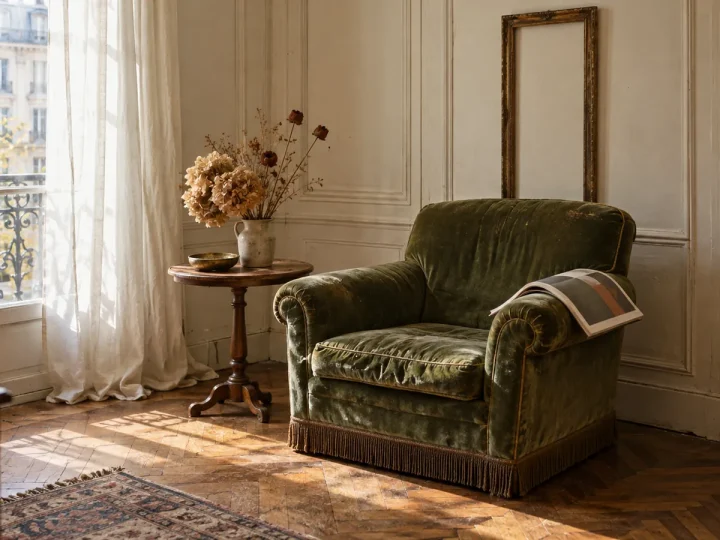
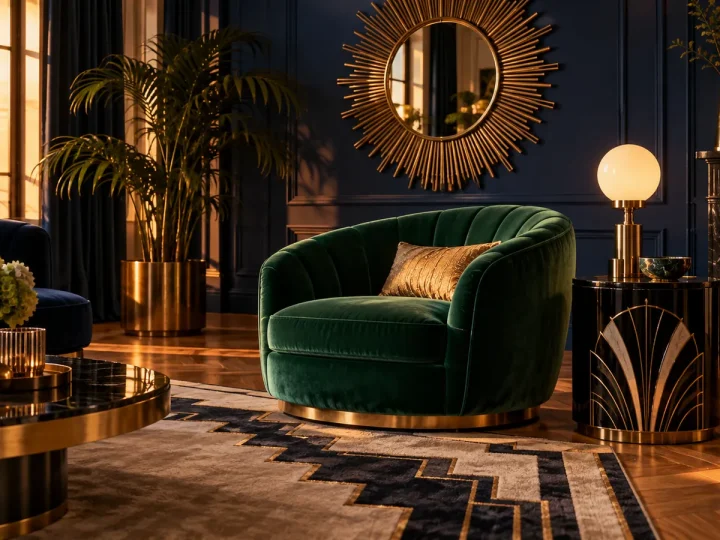
Art Deco is a decorative style born in France in the 1910s, which triumphed at the International Exhibition of Decorative Arts in Paris in 1925, hence its name. It is recognisable by its geometric shapes, its symmetry, its precious materials and its bold colours such as black, gold and emerald green. A hundred years later, it is making a big comeback in our homes. ✨
Here are its origins, its 7 key features to spot it at a glance, its colour palette and 8 ideas to bring it into your home without turning your living room into a film set.
What is Art Deco style?
Art Deco is an artistic movement that touched every area of everyday life: architecture, furniture, objects, fashion, jewellery, typography and, of course, posters. Its ambition: to bring together luxury and fine craftsmanship with the modernity of the machine and of speed.
- Period: from the 1910s to the late 1930s, with a golden age between the two world wars.
- Birthplace: Paris, before it conquered Europe, New York, Miami, Shanghai and Mumbai.
- Keywords: geometry, symmetry, stylisation, elegance, precious materials, contrast.
- Big names: Jacques-Émile Ruhlmann (furniture), Jean Dunand (lacquer), René Lalique (glass), Edgar Brandt (ironwork), Tamara de Lempicka (painting), Cassandre and Paul Colin (posters).
Where does Art Deco come from?
The 1925 Exhibition, its official birth certificate
From April to October 1925, Paris hosted the International Exhibition of Modern Decorative and Industrial Arts, between the Esplanade des Invalides and the Grand Palais. Exhibitors had one rule to follow: show only new creations, with no copies of past styles. Visitors discovered a modern, refined and geometric way of living, which would become the style of an era.
Its influences: from Egypt to the Ballets Russes
Art Deco drew on very different sources, which it mixed with great freedom:
- Cubism, for breaking shapes down into simple volumes.
- The Ballets Russes, which arrived in Paris in 1909, for their bright colours and their taste for the exotic.
- Ancient Egypt, hugely fashionable after Howard Carter discovered Tutankhamun’s tomb in 1922.
- African and pre-Columbian art, for stepped patterns and stylised shapes.
- The machine and speed: ocean liners, trains, cars and planes became models of elegance.
A name given long after the fact
At the time, people spoke of the “modern style” or the “1925 style”. The term “Art Deco” only caught on in 1966, with the exhibition “Les Années 25” at the Musée des Arts Décoratifs in Paris, and then thanks to the book by British historian Bevis Hillier, Art Deco of the 20s and 30s, published in 1968.
Art Nouveau or Art Deco: what is the difference?
They are often confused, yet they are almost opposites. Art Nouveau looks to nature, Art Deco looks to the city and the machine.
| Art Nouveau | Art Deco | |
|---|---|---|
| Period | Around 1890 to 1914 | 1910s to 1939 |
| Lines | Curves, arabesques, “whiplash” lines | Straight lines, geometry, symmetry |
| Inspiration | Flowers, vines, insects, female figures | Machines, speed, the city, Antiquity, Egypt |
| Materials | Wrought iron, carved wood, stained glass | Lacquer, brass, chrome, marble, precious woods |
| Key figures | Alphonse Mucha, Hector Guimard, Émile Gallé | Ruhlmann, Lalique, Cassandre, Lempicka |
| Famous example | Guimard’s Paris metro entrances | The Chrysler Building in New York (1930) |
What are the key features of Art Deco style?
Seven signs help you recognise Art Deco, whether on a façade, a piece of furniture or a poster.
Geometry and symmetry
Everything is constructed and balanced, often symmetrical around a central axis. Shapes from nature are simplified until they become geometric patterns.
Signature motifs
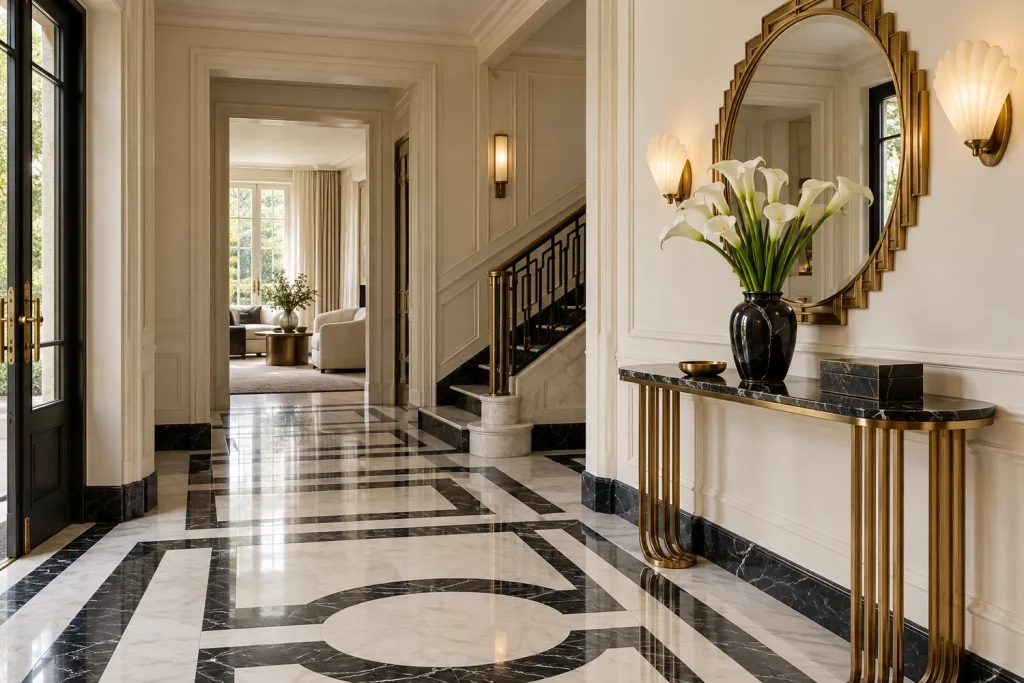
The fan, the rising sun with its spreading rays, chevrons, zigzags and stepped shapes inspired by tiered pyramids. You find them everywhere, from floor tiles to mirrors.
Bold, contrasting colours
Black and gold, emerald green, midnight blue, burgundy, set off with cream or ivory. Art Deco loves strong contrasts and deep shades.
Precious materials
Lacquer, exotic woods such as Macassar ebony, shagreen (stingray skin), marble, brass and glass. Alongside this luxury, chrome and steel brought in industrial modernity.
Controlled curves
Art Deco is not only right angles: armchairs with rounded backs, round mirrors, softened furniture corners. But these curves remain regular and full, far from the arabesques of Art Nouveau.
The play of light
Opalescent glass, bowl wall lights, stepped ceiling lights: light becomes part of the decor. René Lalique’s moulded glass panels adorned the carriages of luxury trains in the late 1920s.
Recognisable graphics and lettering
Capital letters, tall and narrow or very geometric, often built into the image. The poster artist Cassandre even designed his own typefaces, such as Bifur in 1929 and Peignot in 1937.
What are the colours of Art Deco?
There is no single Art Deco palette, but four main combinations, from the most dramatic to the softest.
| Palette | Mood | Where to use it |
|---|---|---|
| Black and gold | Glamorous, evening, Roaring Twenties | Living room, home bar, hallway |
| Emerald green and brass | Elegant and warm | Living room, library, dining room |
| Midnight blue and copper | Deep and cosy | Bedroom, study |
| Dusty pink, terracotta and cream | Sunny and soft, Riviera style | Bedroom, bathroom, kitchen |
The last palette recalls the pastel façades of Miami Beach’s Art Deco district: proof that this style can also be bright and relaxed.
How did the poster become the showcase of Art Deco?
Between the wars, railway and shipping companies commissioned posters to make people want to travel. It was the golden age of the travel poster, and Art Deco gave it its language: flat areas of colour, dizzying perspectives, bold framing and lettering built into the image.
- Cassandre created L’Étoile du Nord and Nord Express in 1927, then the poster for the ocean liner Normandie in 1935, seen head-on like a floating skyscraper.
- Roger Broders drew the beaches and mountains of the South of France and the Alps for the PLM railway company, in bright colours and clean shapes.
- Paul Colin launched his career in 1925 with the poster for La Revue nègre, featuring Josephine Baker.
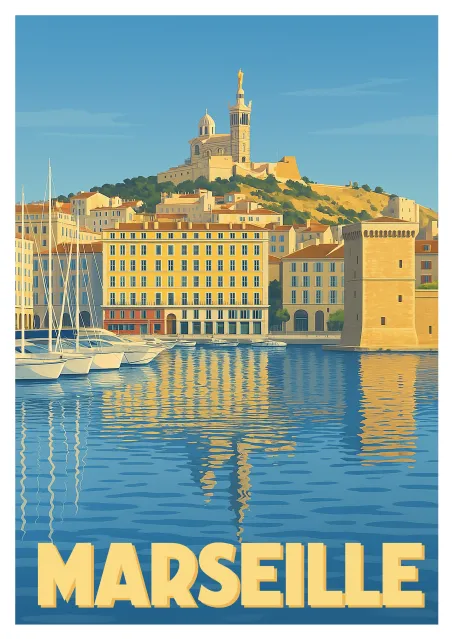
This is exactly the era that inspires our posters. Each one starts from a real photo taken on our travels, reworked into an illustration with bright colours, flat graphic areas and clean shapes, like the tourist posters of the 1930s to 1950s.
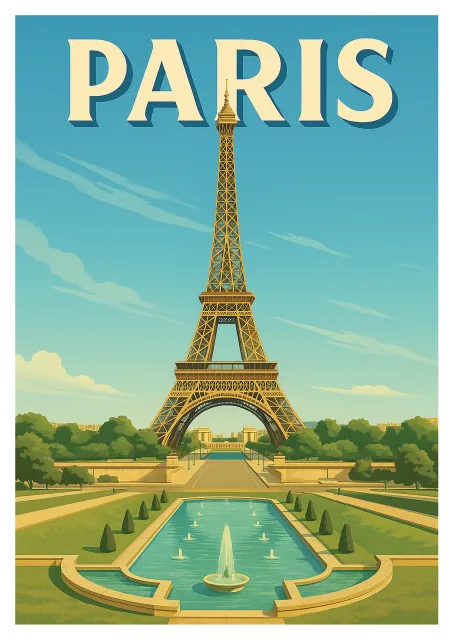
On this Paris poster, you can spot several Art Deco features: a symmetrical composition around the Eiffel Tower, a central perspective that guides the eye and a title in capitals that is part of the image.
How to bring Art Deco style into your home?
The secret of successful Art Deco decor is balance. Two or three well-chosen features per room are enough, mixed with simpler furniture. Here are 8 ideas, from the easiest to the boldest.
A round or sunburst mirror
It is the simplest way to start. A round mirror with a brass frame or a sunburst mirror above a console, and your hallway changes era.
A graphic poster in a black or gold frame
A poster in the style of the 1930s instantly brings in the geometry, flat colours and lettering of Art Deco. Choose an A3 size in a thin black or brass frame, and get the height right: our tips on how to hang a picture frame will help you put it in the right place.
A touch of brass
Furniture handles, a table lamp, a tray, table legs: brass instantly warms up a room. Go for a brushed finish, softer than shiny gold.
Velvet in rounded shapes
A cocktail armchair, a sofa with a rounded back or simply velvet cushions in emerald green, midnight blue or terracotta. Velvet catches the light, like the precious materials of the time.
One geometric pattern, just one
Fan-patterned wallpaper on one wall, a black and white checkerboard floor, a stepped rug or an arched headboard. Choose a single large patterned surface and keep the rest calm.
Opal glass lighting
A globe pendant, a bowl wall light or a mushroom lamp in white glass give off a soft light, very 1930s.
A Roaring Twenties home bar
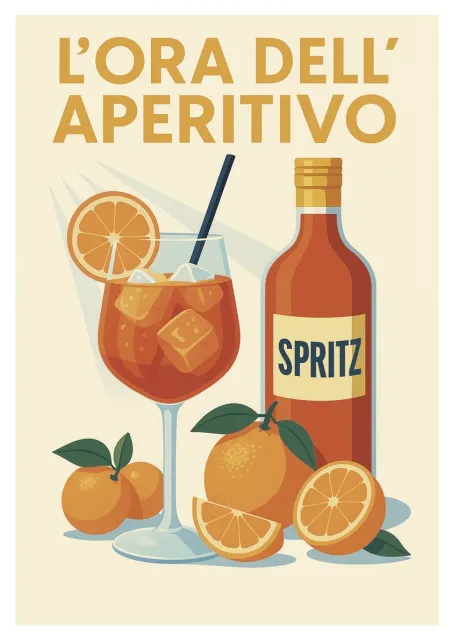
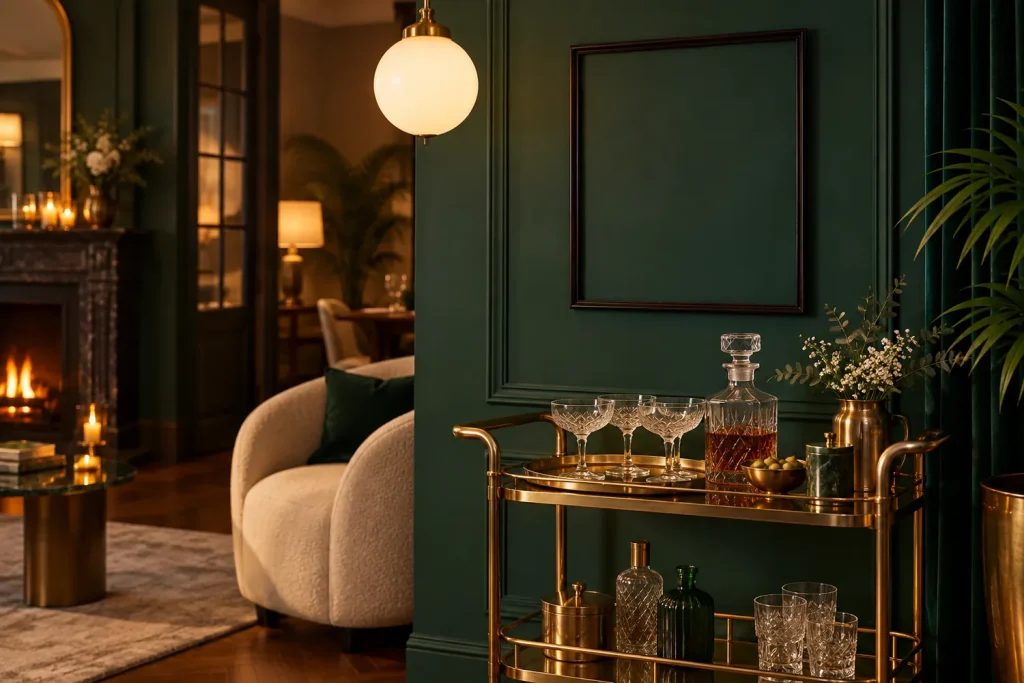
The 1920s were the decade of cocktails. A brass bar cart, a few cut glasses, a decanter and an aperitif poster on the wall: here is a corner that invites you to raise a glass. 🍸
Vintage finds
Flea markets and auctions are full of vases, ornaments, lamps and small pieces of furniture from the 1930s. A single authentic piece gives character to a whole modern interior.
🏛️ Good to know: to see Art Deco for real in France, two museums are well worth a visit: the Musée des Années 30 in Boulogne-Billancourt, and La Piscine in Roubaix, a former Art Deco municipal swimming pool that became a museum of art and industry in 2001. In Paris, the Palais de Chaillot, built for the 1937 International Exhibition, is another great example.
What mistakes should you avoid with Art Deco style?
- Putting everything in the same room: black, gold, velvet, checkerboard and mirrors all together quickly look like a film set. Two or three features are enough.
- Overdoing shiny gold: brushed brass or aged bronze look more authentic.
- Forgetting the walls: without a deep colour or a graphic poster, Art Deco furniture loses part of its effect.
- Confusing it with Art Nouveau: if it is plant-like and sinuous, it is not Art Deco.
Our posters with a 1930s feel
Frequently asked questions
What is the difference between Art Nouveau and Art Deco?
Art Nouveau (around 1890 to 1914) is inspired by nature: curves, flowers, vines, female figures. Art Deco (1910s to 1939) followed it with straight lines, geometry, symmetry and precious materials, inspired by the machine, speed and the city.
What are the colours of Art Deco?
The signature colours of Art Deco are black and gold, emerald green, midnight blue and burgundy, paired with cream or ivory. A softer version combines dusty pink, terracotta and cream, like the pastel façades of Miami Beach.
Why is it called “Art Deco”?
The name comes from the International Exhibition of Modern Decorative and Industrial Arts, held in Paris in 1925. Yet the term “Art Deco” only caught on in 1966, with an exhibition at the Musée des Arts Décoratifs devoted to the 1925 years.
How can you recognise an Art Deco object?
An Art Deco object is geometric and often symmetrical, with fan, rising sun, chevron or stepped motifs. It combines noble materials such as lacquer, brass, marble, glass or precious woods. Its shapes are stylised, never naturalistic.
What are the most famous Art Deco buildings?
The Chrysler Building (1930) and the Empire State Building (1931) in New York, the Art Deco district of Miami Beach, the Palais de Chaillot in Paris (1937) and the town of Napier, in New Zealand, rebuilt in this style after the 1931 earthquake.
A style that has not aged a day
A hundred years after the 1925 Exhibition, Art Deco still appeals because it combines elegance and joie de vivre. To bring it into your home, start with one wall: a deep colour, a round mirror and a graphic poster. Find our other articles on the art of the poster, or browse our poster collections to find the one that will set the tone.