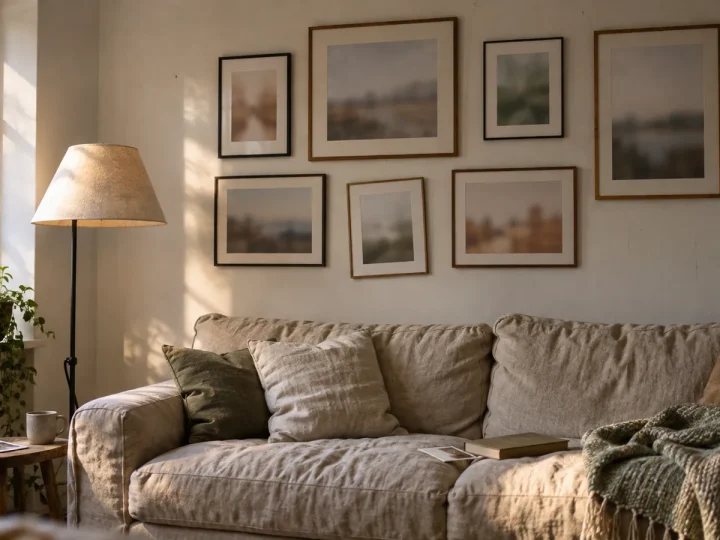
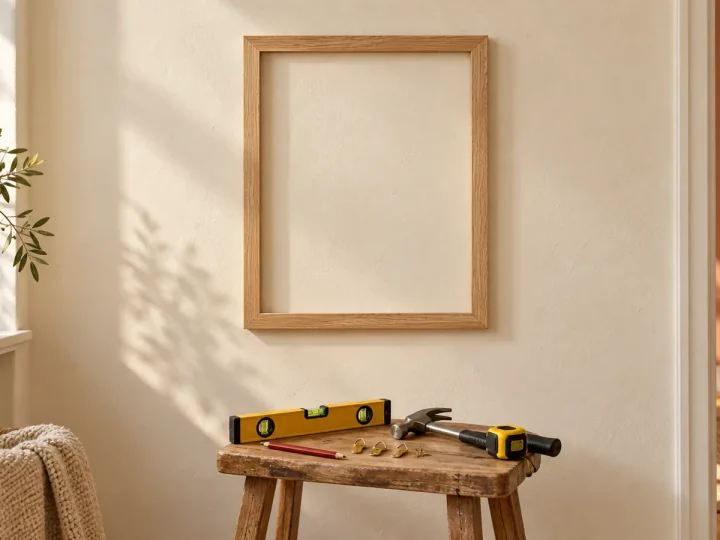
To hang a picture frame, remember one simple rule: the centre of the frame should sit about 150 cm (59 in) from the floor, at eye level. Above a piece of furniture, leave 15 to 25 cm (6 to 10 in) between the furniture and the bottom of the frame. After that, it all comes down to choosing the right fixing, which depends on your wall and the weight of the frame. Here is the complete method, from measuring up to a perfectly straight frame.
What you need to hang a frame
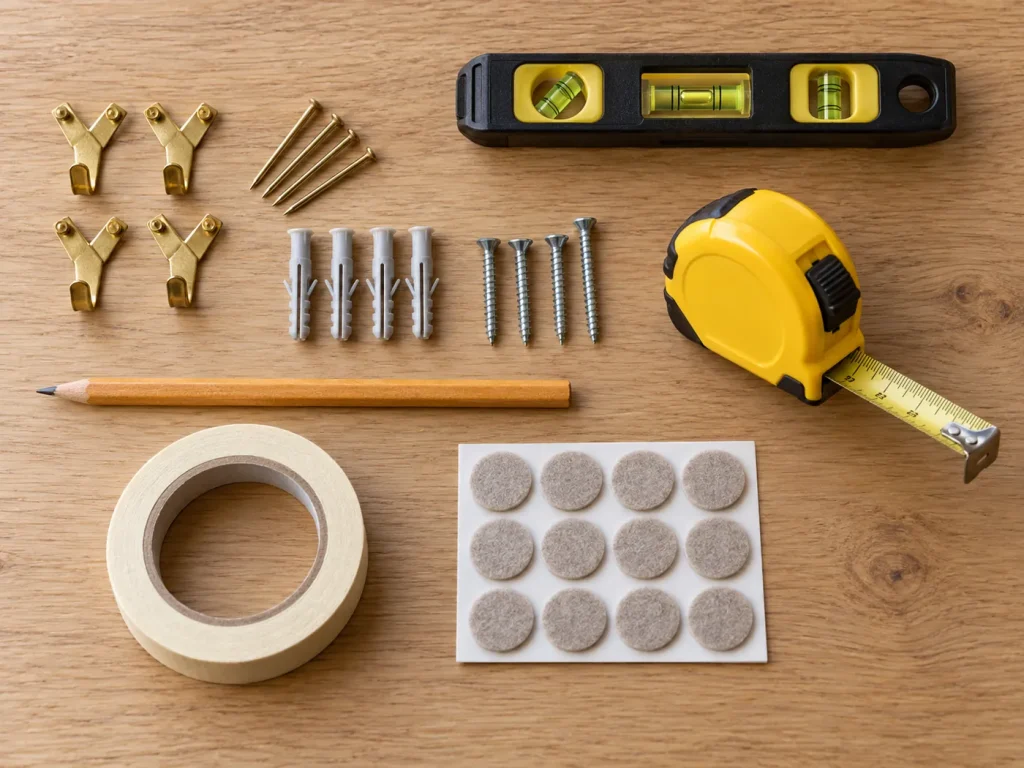
- a tape measure and a pencil;
- a spirit level (or the level app on your phone);
- the right fixing for your wall: picture hooks with pins, screws and wall plugs, or plasterboard fixings;
- a hammer, or a drill if your wall needs it;
- masking tape, handy for marking the spot without marking the wall;
- a few felt or silicone bumper pads to keep the frame straight.
At what height should you hang a frame or a picture?
Height is what makes the difference between a successful wall and a frame that seems to “float”. Museums and galleries place the centre of artworks between 145 and 155 cm from the floor: the average eye level of a standing adult. At home, adapt it to the room:
| Where to hang it | The right height |
|---|---|
| Bare wall (hallway, landing, living room) | Centre of the frame 150 cm from the floor |
| Above a sofa | Bottom of the frame 15 to 25 cm above the backrest |
| Above a sideboard or console | Bottom of the frame 15 to 25 cm above the furniture |
| Above a bed | Bottom of the frame 20 to 30 cm above the headboard |
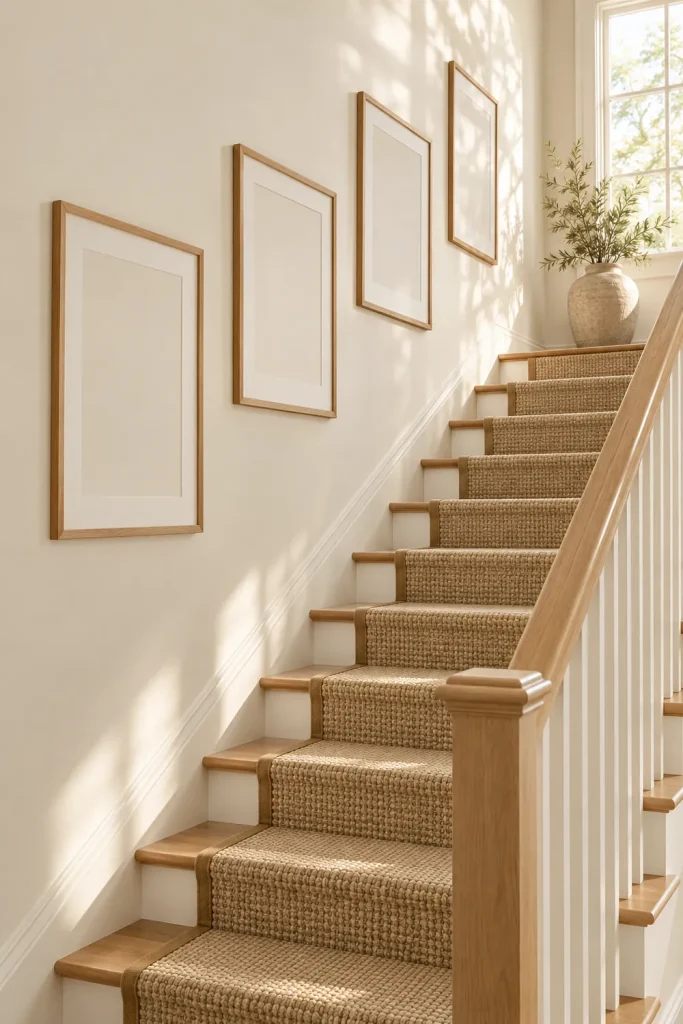
| On a staircase | Centre 150 cm above each step, following the slope |
| Dining room | Slightly lower (centre around 140 cm), as people look at it seated |
📏 The two-thirds rule: above a piece of furniture, the frame (or group of frames) should be about two thirds of the width of the furniture. Smaller, it looks lost. Bigger, it overwhelms the furniture.

How to hang a frame in 6 steps
Choose the spot
Hold the frame against the wall, or cut a kraft paper template to its size and stick it up with masking tape. Step back two or three metres: it is the best way to judge the height and the balance with the furniture.
Mark the centre
Mark with a pencil where the centre of the frame should be, for example 150 cm from the floor on a bare wall.
Work out where the nail goes
The nail doesn’t go at the centre of the frame, but where the hanger will rest. The calculation is simple:
- take the height of the centre (for example 150 cm);
- add half the height of the frame (for a 40 cm frame: + 20 cm, which gives 170 cm, the top of the frame);
- subtract the distance between the top of the frame and the hanger when pulled taut (for example 5 cm).
Result: the nail goes 165 cm from the floor. For a frame with a wire, pull the wire up with your finger before measuring.
Put up the fixing
Hammer in the hook or drill according to your type of wall (see the table below). On a fragile wall, stick a piece of masking tape where the hole goes: it stops the plaster from crumbling.
Hang and level
Hang the frame, place the spirit level on top and adjust. For frames wider than 40 cm, two fixing points spaced apart keep it straight much more easily than a single one.
Secure it
Stick two bumper pads on the lower corners at the back of the frame. They stop it tilting every time someone walks past and protect the wall.
Which fixing for your wall and the weight of the frame
This is what brings down the most frames. 🔨 Tap the wall: a solid sound means a masonry wall (concrete, brick, stone), a hollow sound means a plasterboard partition.
| Type of wall | Light frame (under 2 kg) | Heavy frame |
|---|---|---|
| Plasterboard (hollow wall) | Picture hook with a fine pin, or a plasterboard hook | Cavity wall anchor (Molly type) and screw |
| Concrete, brick | Picture hook with a hardened steel pin | Drilling, wall plug and screw |
| Stone | Drill into the mortar joint, wall plug and screw | Drill into the mortar joint, wall plug and screw |
| Wood, panelling | Small nail or screw directly | Screw into a stud |
Always check the maximum load shown on the fixing’s packaging, and allow some margin. For a heavy or large frame, always use two fixing points.
Hanging a frame with no hanger
Some frames come without any hanging system, or with only an easel stand. Two simple solutions:
- a sawtooth hanger: a small toothed metal plate nailed or screwed to the centre of the top of the frame, ideal for light frames;
- two D-rings and a wire: screw a D-ring into each side of the frame, a third of the way down, and stretch a picture wire or strong cord between them. The wire should stay slightly slack and not show above the frame once hung.
And how do you hang a poster?
A framed poster is a light frame: in A4 or A3, it usually weighs less than 2 kg, especially with acrylic glazing. A simple picture hook is enough in most walls. For an A3 poster, go for a frame in its exact size, or a larger frame with a mount that gives the illustration room to breathe.

Above a sideboard or a sofa, a single poster often looks small. Hang two or three posters of the same size instead, aligned along the top or the centre, with 5 to 8 cm between each frame: the group respects the two-thirds rule and tells the story of several places at once.
Three posters to build a wall



Renting, or don’t want to drill? Removable adhesive strips, adhesive picture ledges or picture rails also let you hang light frames without damaging the wall. Just check the maximum weight and apply them to a clean, dry wall.
Frequently asked questions
At what height should you hang a picture?
Place the centre of the picture about 150 cm (59 in) from the floor on a bare wall. Above furniture, keep 15 to 25 cm between the furniture and the bottom of the picture. In a room where people mostly sit, such as a dining room, go slightly lower, around 140 cm.
How do you hang a frame on plasterboard?
For a light frame, a picture hook with a fine pin or a plasterboard hook is enough. For a heavier frame, use a cavity wall anchor, Molly type, which opens out behind the board, with a suitable screw. If possible, fix the frame into a metal stud of the partition.
How do you hang a heavy frame?
Identify the type of wall, choose wall plugs rated for the load (with some margin) and spread the weight over two fixing points. For very large frames, a picture rail or a batten fixed to the wall is still the safest solution.
How do you hang a frame perfectly straight?
Use two fixing points at the same height, checked with a spirit level, rather than a single central nail. Add bumper pads at the back: the frame won’t move again.
Over to you
The right height, the right fixing and a spirit level: that is all a frame needs to find its place. Find more of our decor tips, or browse our travel posters by destination to dress your walls with places you love.