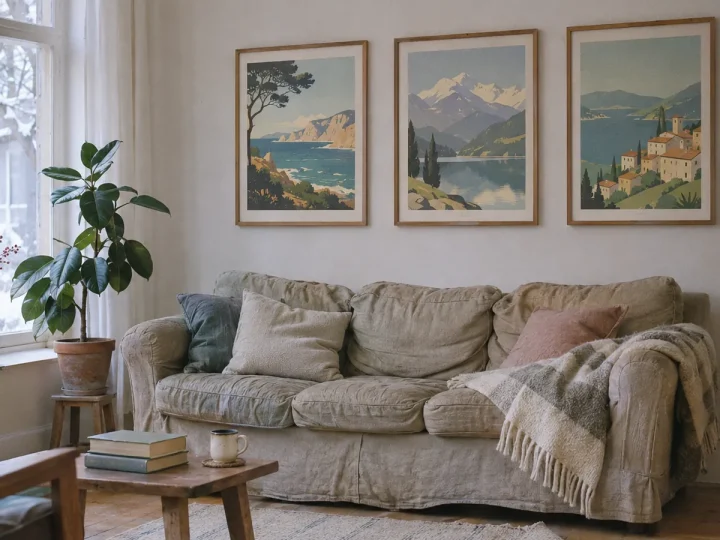
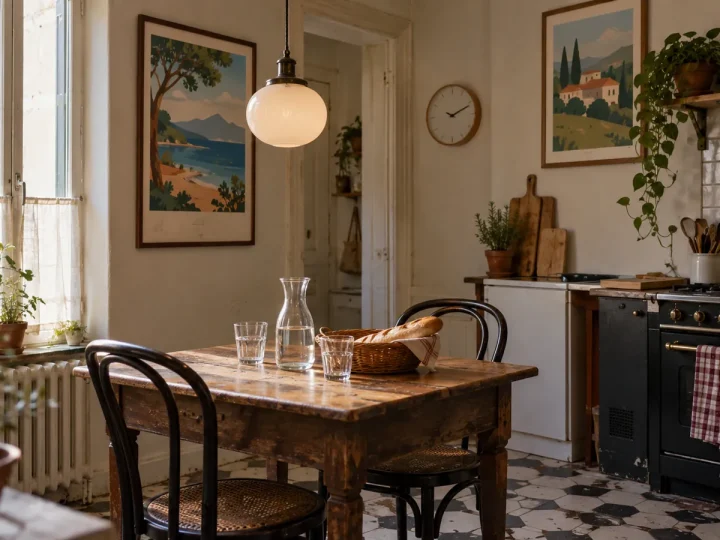
For vintage bistro decor at home, focus on three things: a vintage or vintage-style poster on the wall, bentwood chairs around a simple table, and low, warm lighting. Add a tiled floor, a chalkboard and sturdy tableware, and your kitchen instantly takes on the feel of an old French café.
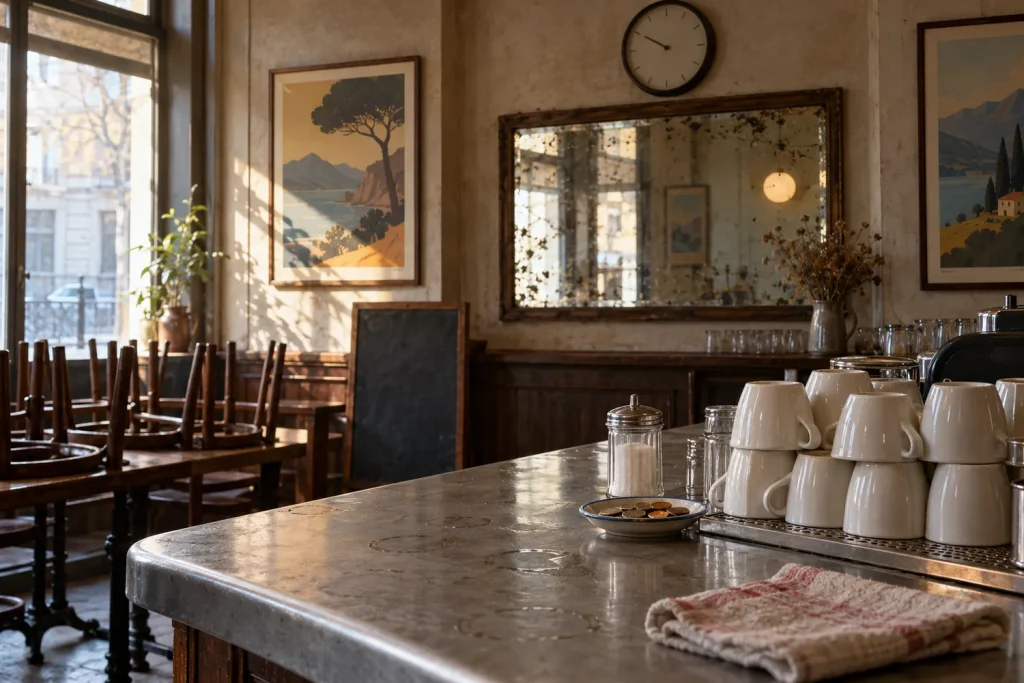
Push open the door of an old neighbourhood bistro. The counter still shines from its last wipe, the coffee machine hisses, someone folds a newspaper. On the wall, between the speckled mirror and the clock that runs slow, a faded advertisement praises a chocolate or a stock cube that vanished long ago. Nobody really looks at it, and yet it gives the place its age and its character.
That poster, more than any piece of furniture, is what makes a bistro feel like a bistro. Here is how to choose one, and how to build a bistro kitchen or dining room around it without ending up with a themed brasserie.
Where does the bistro spirit come from?
A bistro is a small neighbourhood café-restaurant, more modest than a brasserie: a counter, a few tables, simple cooking. In Paris, many were run by people from the Auvergne, the “bougnats”, who came up from the Massif Central to sell wood and coal, then drinks. Their decor took shape in the early 20th century: wooden or iron tables, bentwood chairs, tiles, mirrors, and advertisements on the walls.
That world has shrunk a great deal: France had around 400,000 bistros in 1945, and 40,000 in 2021. Perhaps that is why people love to bring it back to life at home. Since 27 September 2024, the social customs of French cafés and bistros have been listed in France’s national inventory of intangible cultural heritage, and a bid for UNESCO recognition is under way.
Where does the word come from? A plaque in Montmartre says that in 1814, Russian soldiers hurried café owners by shouting “bystro”, “quickly” in Russian. It is a charming legend, but linguists reject it: the word only appears in 1884. It more likely comes from “bistraud”, a word from the Poitou region for a servant, which came to mean a wine seller.
The vintage poster, the soul of the bistro wall
The walls of old cafés were covered with advertisements: aperitifs, coffee, chocolate, stock cubes, mineral water. Brands had them hung right where customers waited for their coffee or their drink. The great poster artists worked on them, starting with Leonetto Cappiello, who made a single unexpected figure leap out of a dark background.
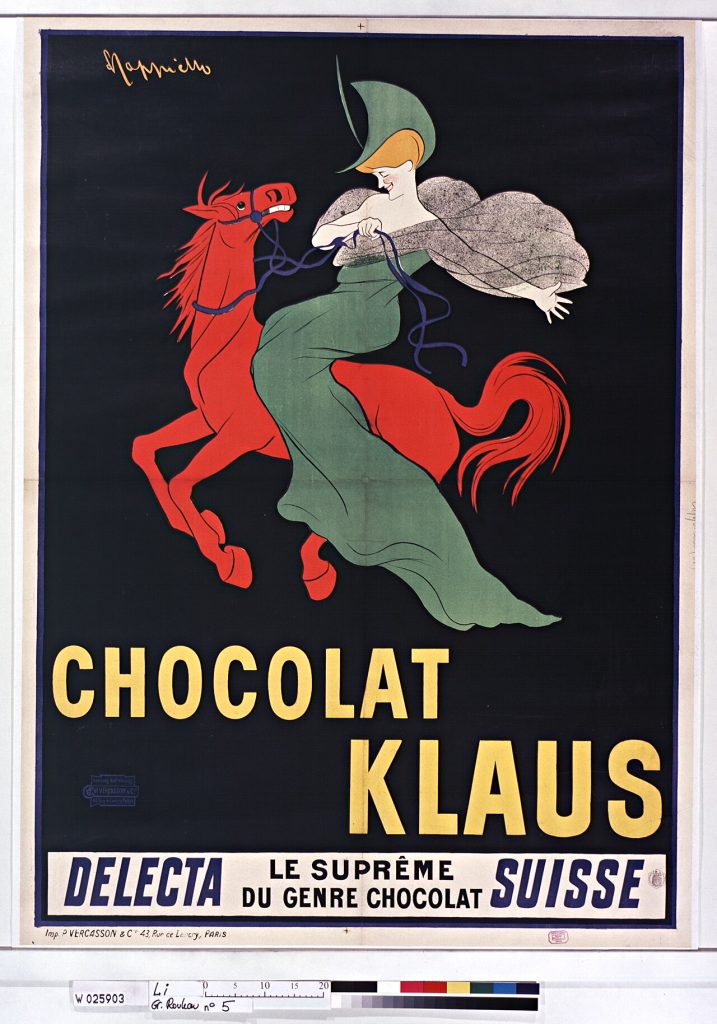
For Chocolat Klaus, in 1903, Cappiello drew a woman in green on a red horse: nothing to do with chocolate, and that is exactly what catches the eye. Almost thirty years later, for Bouillon Kub, he kept only a black bull’s head on a yellow background and a red cube. Two ways to do bistro: Belle Époque whimsy or the strong, stripped-back image of the 1930s.
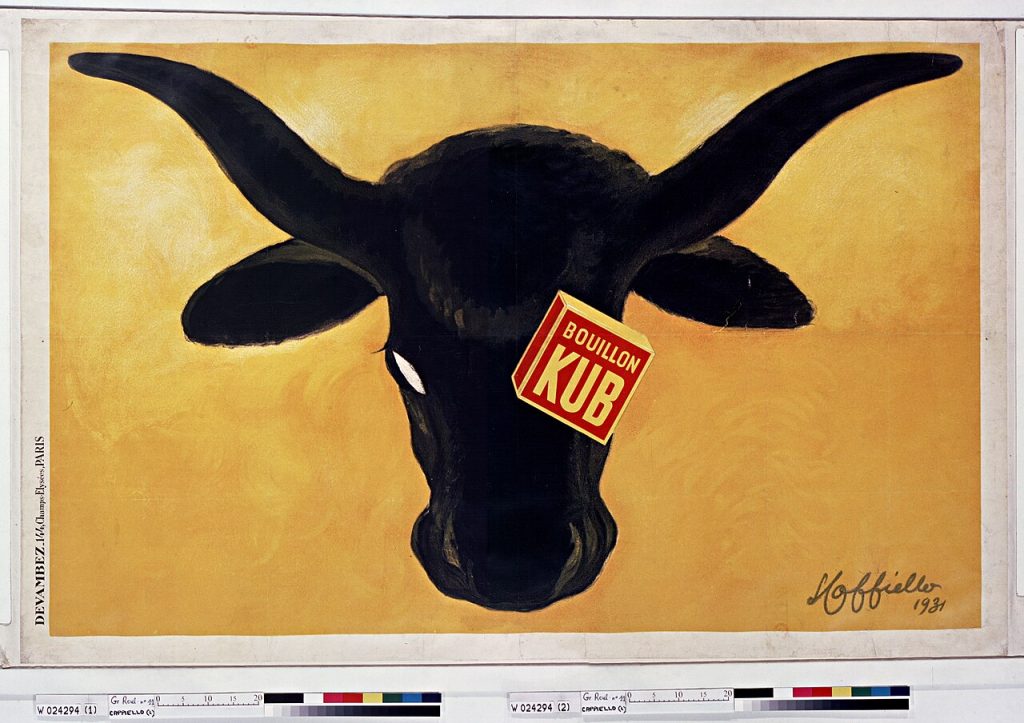
These two advertisements and their author have their place in our article on the 10 poster artists who invented the modern poster.
Original, reproduction or today’s poster?
A genuine vintage bistro poster can be found at flea markets, auctions or specialist dealers. It has a unique charm, but also its constraints. Before you start looking, see what suits your wall and your budget.
| Original poster | Reproduction of an old advert | Illustrated poster of today | |
|---|---|---|---|
| What it is | A period lithograph, often linen-backed | A copy of an old advertisement | A recent creation in a vintage style |
| Size | Often large, over 1 m tall | Varies | Standard sizes (A5, A4, A3 in our shop) |
| Budget | High, depending on the artist and condition | Low | €15 to €24 in our shop |
| Frame | Custom-made, often costly | Standard | Standard, easy to find |
| What it tells | A brand from the past | A brand from the past | A place or a moment you love |
An old advertisement talks about a brand; an illustrated poster of today can talk about you. That is what we try to do with our posters: keep the flat areas and warm colours of café advertisements, but show a real place, such as a counter by Marseille’s Old Port at pastis time or the lanes of the Panier district.
The spirit of southern French bars
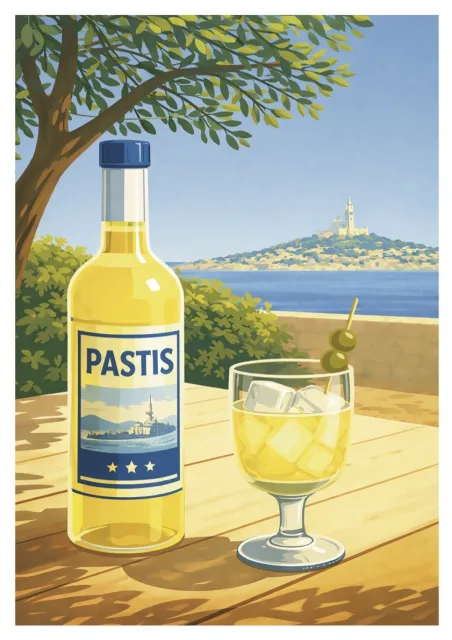
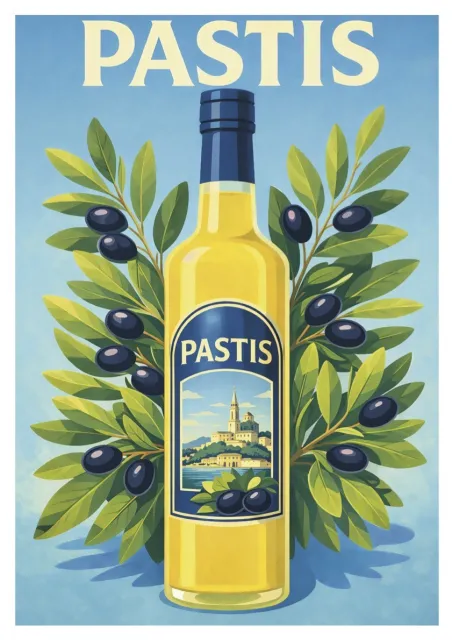
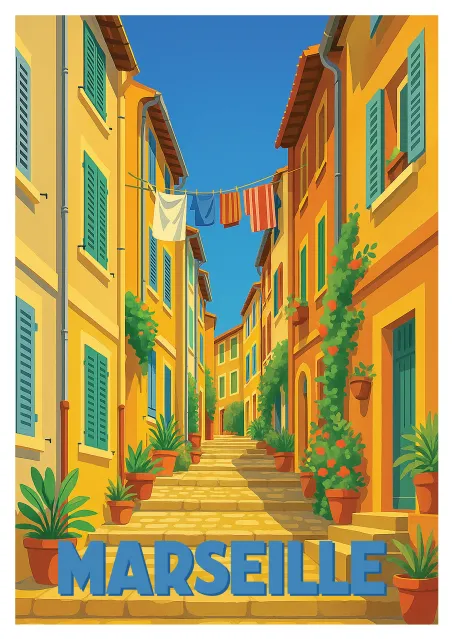
These posters celebrate the aperitif: please drink responsibly.
10 bistro decor ideas for the kitchen
No need to redo everything. Here are the ten ideas that matter most for a kitchen with a Parisian bistro feel, from the simplest to the most ambitious:
- Hang a poster above the table. In A3 (29.5 x 41.9 cm), with the bottom of the frame about 25 cm above the tabletop, or a little higher if someone sits with their back to the wall.
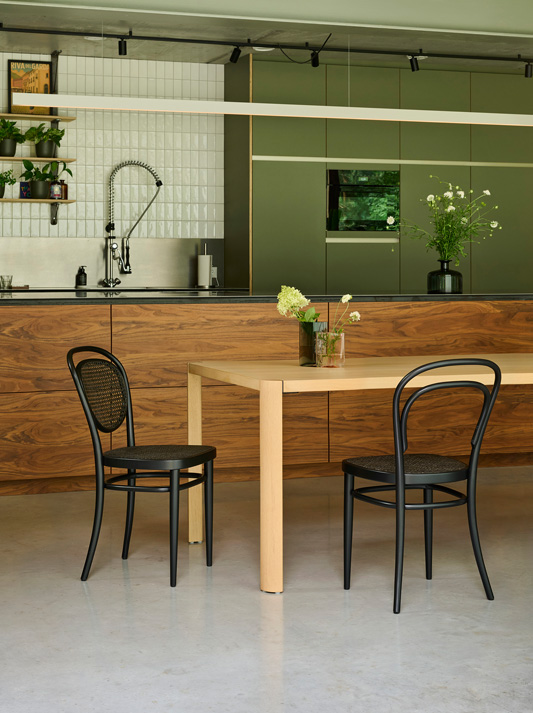
- Change the chairs. Bentwood chairs, black or natural wood, even mismatched: they are the most recognisable sign of a bistro.
- Choose a simple table. Raw wood, a marble top or a pedestal table on a cast iron base: small, round or square, made for two or four.
- Bring the light down. An opaline or enamel pendant, hung fairly low above the table, with a warm bulb.
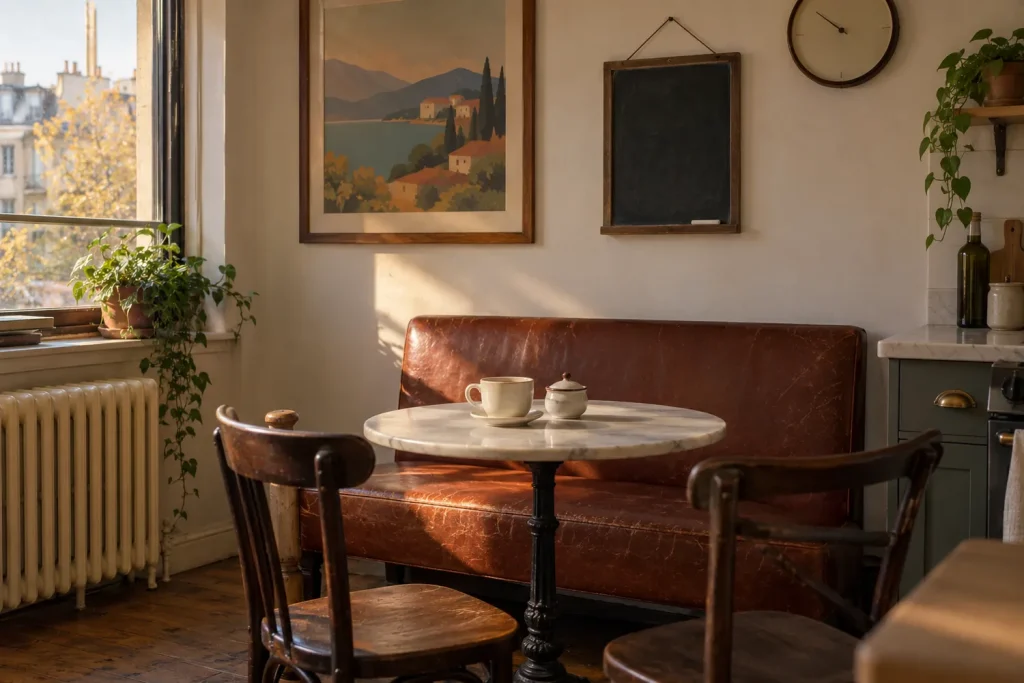
- Hang a chalkboard. For the shopping list, the Sunday menu or the word of the day. It lives and changes, like a real bistro’s.
- Bring out sturdy tableware. Thick-rimmed white cups, a carafe, a jug, bistro glasses (we talk about them in our article on home bar ideas).
- Lay the tablecloth. A red and white gingham cloth for a country inn feel, or a white cloth covered with embossed paper, as on bistro tables.
- Hang a mirror and a clock. A large, slightly speckled mirror makes the room look bigger, as behind a bar counter, and a round clock with black numerals recalls the one in the café across the street.
- Add a bench. Against a wall, a leather or leatherette bench around a small table creates a real bistro corner, and saves space.
- Think about the floor. Cement tiles, small black and white tiles or terracotta. If the floor stays as it is, a checkerboard rug already does a lot.
The ultimate bistro chair was born in Vienna: Michael Thonet’s No. 14, from 1859, made of solid wood bent with steam. Thirty-six disassembled chairs fitted into a one cubic metre box, which meant it could be shipped all over the world. Around 50 million were sold between 1859 and 1930, and Thonet still makes it today, under the name 214. ☕
The mistakes that turn a kitchen into a themed brasserie
The bistro spirit depends on very little, and it is quickly lost when you overdo it.
- Piling up advertisements. One strong poster is better than ten plaques and signs crammed together. A real bistro had a few, not a whole wall.
- Buying everything new and matching. A bistro is made of pieces that have lived: mismatched chairs, a chipped carafe, a marked table. Mix new with second-hand.
- Forgetting that you live there. It is not a film set: keep a practical kitchen, with clear surfaces and enough light to cook.
- Choosing a poster that means nothing to you. An advert for a vanished brand is fun for a while. A place where you once had a coffee, a harbour, a village square, is a pleasure to look at every day.
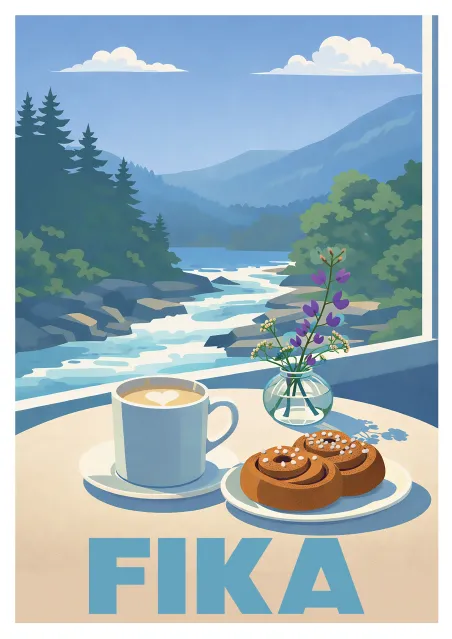
Morning coffee, taken standing up or sitting by the window, is the first ritual of the bistro. A poster that celebrates it, even far from Paris, belongs perfectly in the kitchen.
Frequently asked questions
What poster suits a bistro kitchen?
A poster with warm colours and bold flat areas, in the spirit of café advertisements: a bar counter, a terrace, a harbour or a local speciality. A single A3 poster above the table is enough to set the tone.
How can you tell an original vintage poster?
An original poster is a lithograph printed at the time: large format, thin paper often backed with linen, the printer’s name at the bottom, faint fold marks. A reproduction has thicker paper, a smaller size and a printing screen visible under a magnifying glass. If in doubt, ask a specialist dealer.
Which chair for bistro decor?
The bentwood chair, heir to Thonet’s No. 14 (1859), is the most iconic. Folding metal chairs and woven rattan chairs, typical of Parisian café terraces, also work well.
What is the difference between a bistro and a brasserie?
A bistro is a small neighbourhood café-restaurant, with a counter, a few tables and simple cooking. A brasserie is larger, serves food all day and originally brewed its own beer. For decor, the bistro is more intimate: a few chairs, a poster, low lighting.
Which colours for bistro decor?
A cream or off-white background, dark wood, black for the chairs and lights, and touches of red, bottle green or yellow, the colours of old advertisements.
The last coffee
A bistro is above all a place where you take your time. A table, two chairs, low lighting and a poster you love: at home, that is enough too. To hang it at the right height, follow our guide on how to hang a picture frame, and browse all our food and drink posters and our aperitif collection.