PLM posters are the travel posters commissioned by the Paris-Lyon-Mediterranean railway company to draw travellers to the French Riviera, Provence and the Alps. Signed by artists such as Hugo d’Alési and Roger Broders, they shaped the image of holidays in the sun, before the company became part of the SNCF, the French national railway, in 1938. 🚂
Here is their story, the artists who drew them, 4 Roger Broders posters worth knowing, how to spot an original and how to bring their spirit into your home.
What is a PLM poster?
- The company: the PLM was founded on 3 July 1857 through the merger of several companies. It ran the main Paris-Lyon-Marseille line, extended to Ventimiglia along the Mediterranean, as well as the Alpine lines.
- The posters: large colour lithographs, pasted up in stations and travel agencies, promoting a destination served by train.
- The destinations: the French Riviera, Provence, the lakes and resorts of the Alps, and also Corsica, Algeria and Tunisia, reached by connecting boats.
- The heyday: from the late 19th century to 1937. On 1 January 1938, the PLM was merged into the brand-new SNCF.
How did the train invent the French Riviera?
A line to the Italian border
Before the railway, getting from Paris to Nice took several days. With the Marseille-Ventimiglia line, the coastal towns from Toulon to Menton were suddenly just one night’s train ride from the capital. Wealthy Parisians and European aristocrats got into the habit of spending the winter there, in the sun.
A name coined in 1887
The French name for the Riviera, “Côte d’Azur”, first appeared in 1887, from the pen of the writer Stéphen Liégeard, who used it as the title of his book about the Mediterranean coast. The name caught on, and PLM posters gave it its colours: deep blue sea, umbrella pines, palm trees and white villas.
From winter resort to summer beach
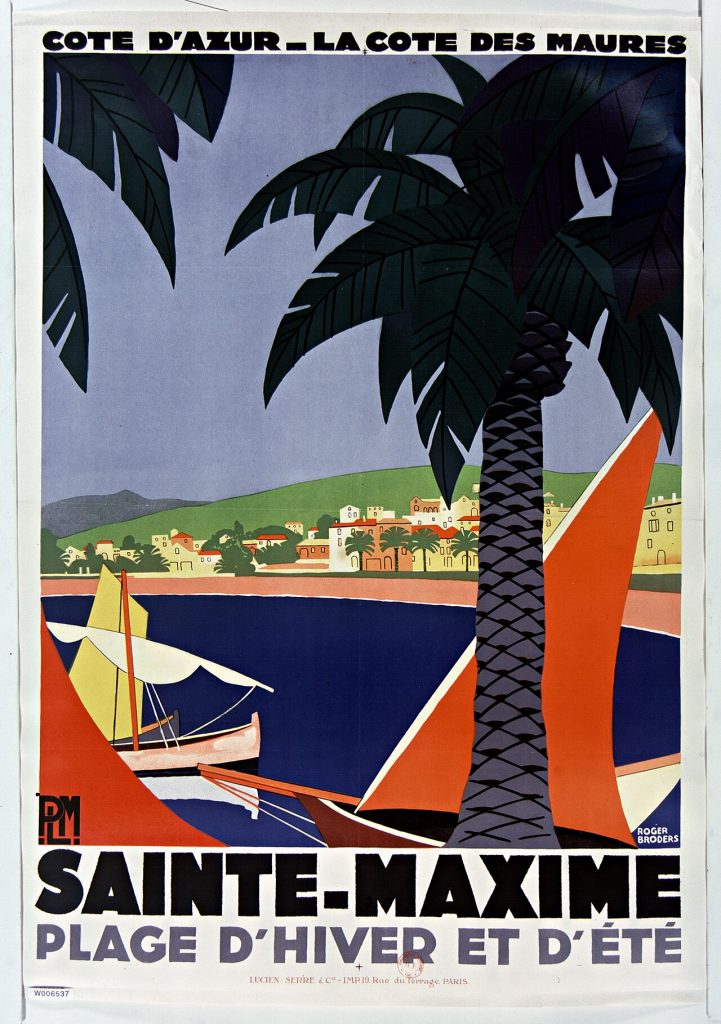
For a long time, the Riviera was a winter destination: people went there for their health and strolled in overcoats. In the 1920s, the fashion for sea bathing and sunshine changed everything. The Sainte-Maxime poster drawn by Roger Broders in 1928 spells it out: “winter and summer beach”. ☀️
The Blue Train, the legend of the Riviera
The most famous train to the Riviera was the Calais-Méditerranée-Express, run by the Compagnie Internationale des Wagons-Lits. On 9 December 1922, it received new steel sleeping cars painted blue and gold, and was immediately nicknamed “Le Train Bleu”, the Blue Train. Coco Chanel, Jean Cocteau and Marlene Dietrich were among its regulars. In Paris, the Le Train Bleu restaurant at Gare de Lyon, decorated with paintings of the destinations along the line, keeps its memory alive.
Who were the PLM poster artists?
Hugo d’Alési, the pioneer
Born in 1849 and died in 1906, Hugo d’Alési was one of the most prolific poster artists for the railway companies in the late 19th century. His highly detailed posters look like landscape paintings: panoramic views of Menton or Mont Blanc, full of detail.
Roger Broders, the master of flat colour
Born in Paris in 1883 and died in 1953, Roger Broders is the great name of the PLM poster. Between 1922 and 1932, he drew dozens of posters for the company featuring the Riviera, Provence and the Alps. His style, typical of Art Deco, relies on large flat areas of colour, bold geometry and deep perspectives, often with a tree or a figure in the foreground to frame the landscape. His motto: “You pass by, you see, you record”.
And the others
The PLM also called on the illustrator Abel Faivre and many other poster artists. Among rival companies, Cassandre created the famous L’Étoile du Nord poster for the Northern Railway in 1927. As his work is still under copyright, we do not reproduce it here, but you will find it in our article on Art Deco style.
4 Roger Broders posters worth knowing
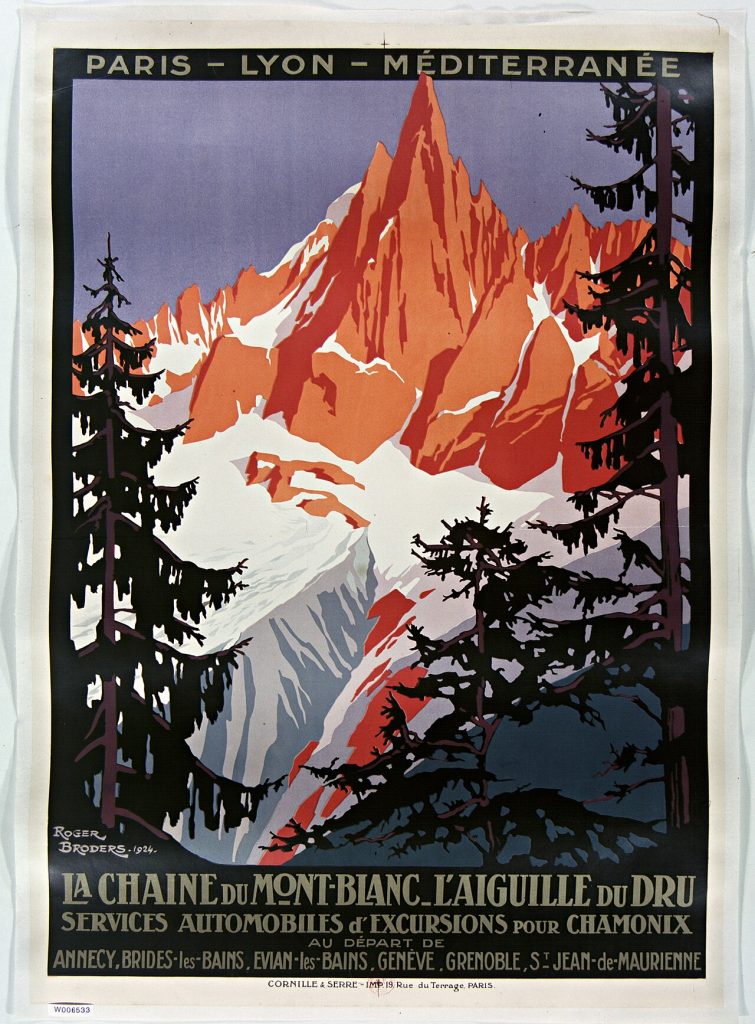
The Mont Blanc range, the Aiguille du Dru (1924)
The Aiguille du Dru, set ablaze by the sun, rises between two almost black fir trees. The poster promotes coach excursions to Chamonix from Annecy, Évian, Geneva or Grenoble: train and road were already working together.
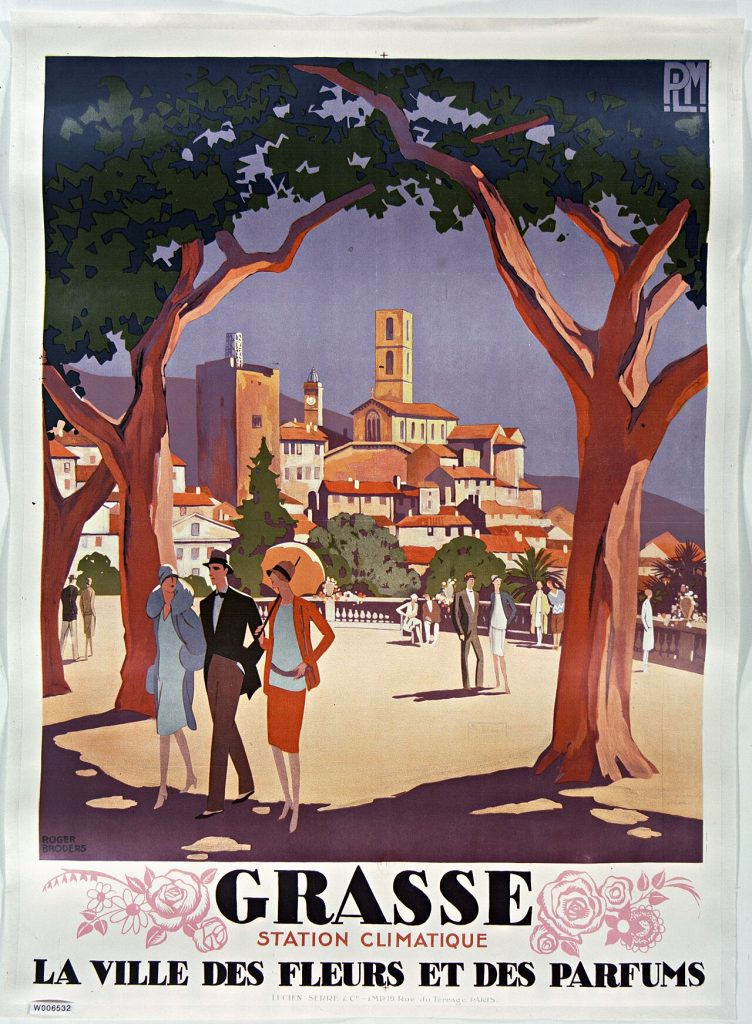
Grasse, the town of flowers and perfumes (1927)
Beneath two large trees, elegant Roaring Twenties strollers admire the hilltop old town. Broders sells Grasse as a “climatic resort”, proof that the hinterland also had its place in Riviera holidays.
Sainte-Maxime, winter and summer beach (1928)
A huge palm tree cuts the image in two, red and ochre sails fill the foreground, and the little town stretches out at the back of the bay. It is one of Broders’ most graphic compositions, and a record of the arrival of summer holidays on the Riviera.
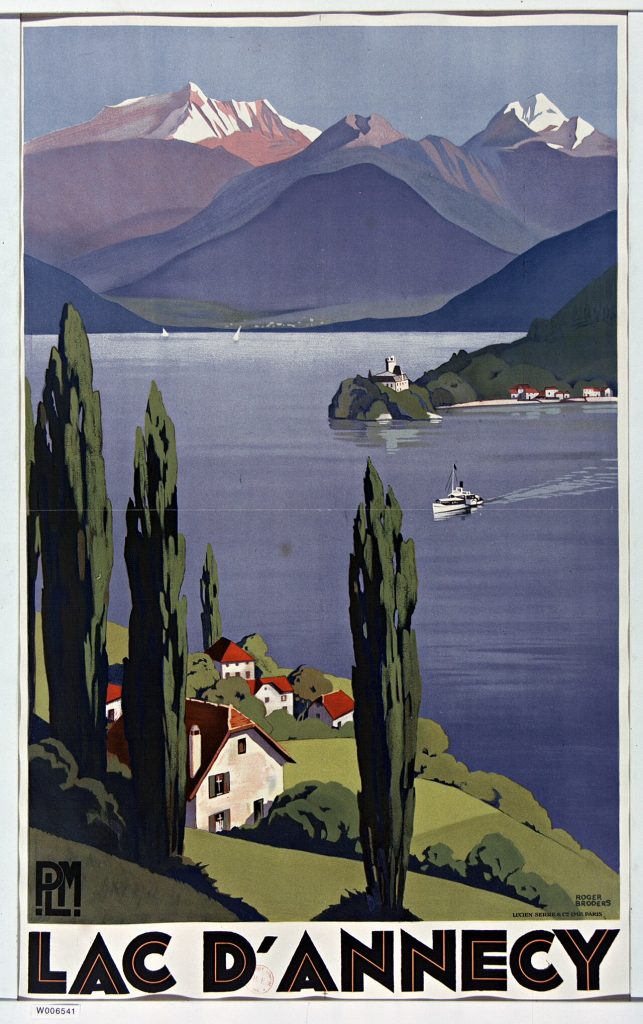
Lake Annecy (1930)
Slender cypresses, a red-roofed house, a steamboat leaving its wake and snowy peaks in the distance: the poster gives Lake Annecy the air of an Italian lake. It is probably one of the most beautiful mountain posters of the period.
How do you recognise the style of PLM posters?
| Graphic feature | What you see | Why |
|---|---|---|
| Flat colour | Large areas of solid colour, no gradients | Readable from afar, on a station platform |
| The foreground | A tree, a palm, a sail framing the view | To add depth and draw the eye in |
| The light | Clear skies, coloured shadows | To promise sunshine, especially to Parisians in winter |
| The lettering | The place name in large capitals | To turn the place into a brand |
| The logo | The letters PLM in a corner | A reminder that you get there by train |
| The printer’s name | At the bottom, in small print | A legal requirement, useful for dating the poster |
What happened to the posters after the SNCF was created?
On 1 January 1938, the major private railway companies, including the PLM, were merged into the Société nationale des chemins de fer français. The SNCF carried on the tradition of the travel poster and, for decades, kept commissioning posters of regions and resorts from poster artists. Vintage SNCF posters from the 1940s to the 1970s are now sought after by collectors, just like PLM posters. As many of their artists died less than 70 years ago, a large share of them are still under copyright.
How do you spot an original PLM poster?
- The technique: originals are lithographs. Under a magnifying glass, you see the grain of the stone, not the regular dot pattern of modern printing.
- The printer’s name: for example Lucien Serre et Cie or Cornille et Serre, in Paris, at the bottom of the poster.
- The size: originals are large, around one metre tall. A “PLM” poster in A4 size is a reproduction.
- Linen backing: originals sold at auction are often mounted on linen to protect them.
- The price: an original in good condition sells for hundreds, even thousands of euros. A price that seems too low should raise suspicion.
Where can you see PLM posters?
- Gallica, the digital library of the Bibliothèque nationale de France, has digitised many PLM posters in high definition, free to view online.
- Wikimedia Commons gathers part of these scans, with their dates and credits.
- The Le Train Bleu restaurant, at Gare de Lyon in Paris, for the atmosphere of the line and its paintings of PLM destinations.
- Specialist auctions of vintage posters, where you can see and buy originals.
How can you bring the spirit of PLM posters into your home?
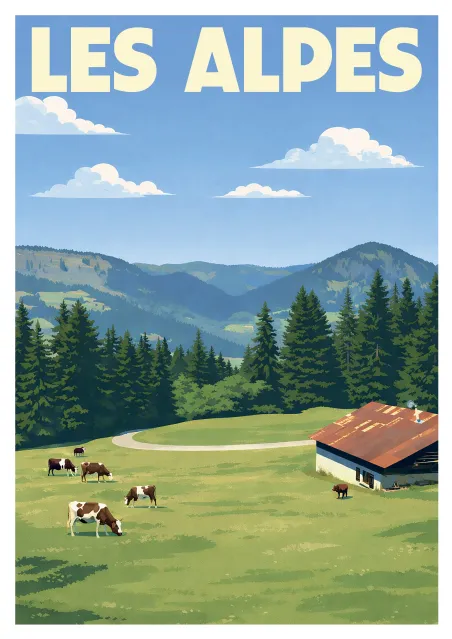
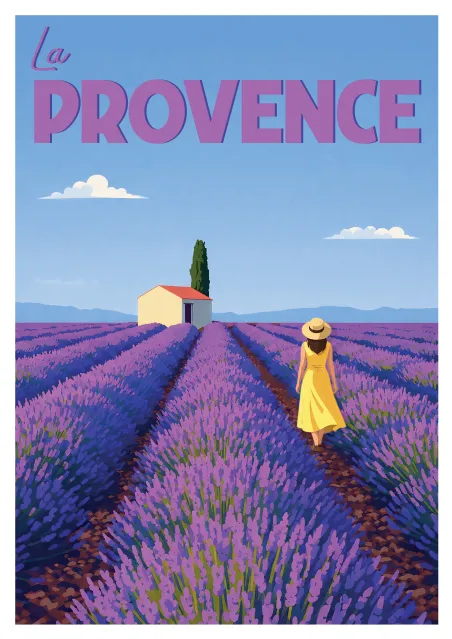
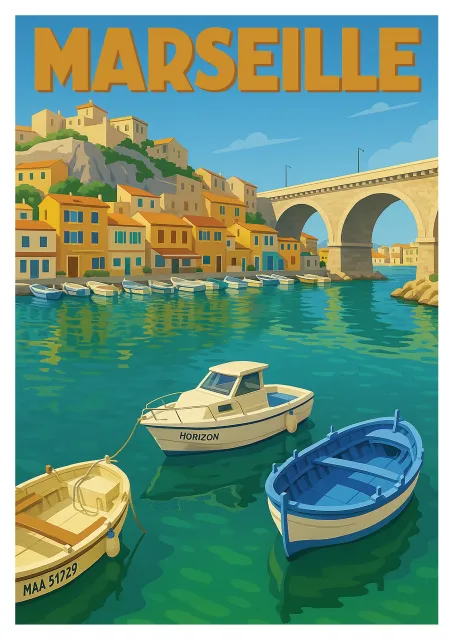
Our posters are directly inspired by this golden age of the travel poster: flat areas of bright colour, clean shapes, wide landscapes. The difference: each one shows a place our family has really visited and photographed. Here is how to pair them with the PLM spirit.
Choose a place on the old line
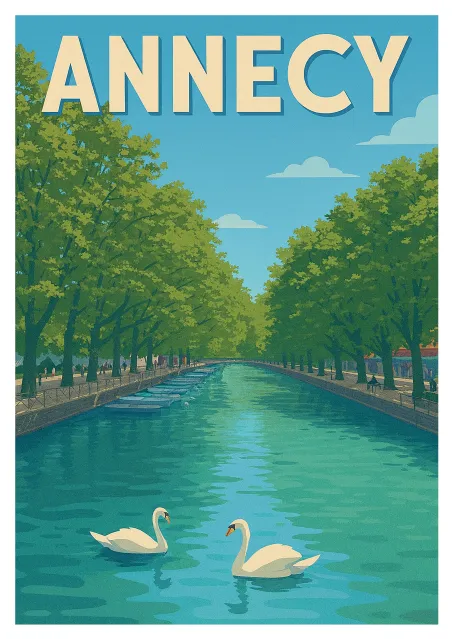
For a nod to history, choose a destination on the old PLM network: the Riviera, Provence, the lakes and mountains of the Alps. Lake Annecy, which Broders drew in 1930, is the perfect example.
An island on the Riviera
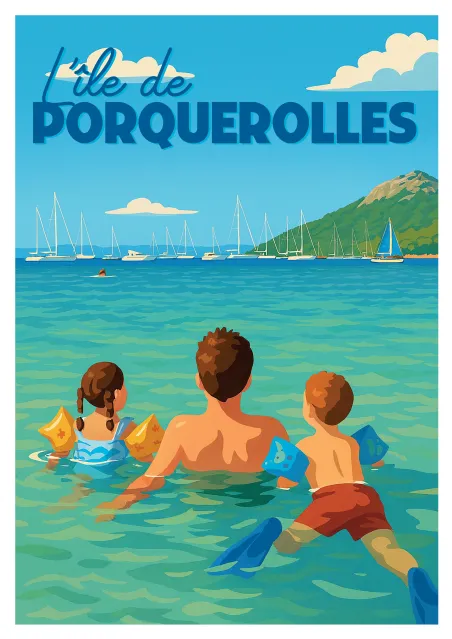
Even today, shuttle boats run from Sainte-Maxime to the island of Porquerolles. Its Notre-Dame beach, often considered the most beautiful on the island, was voted Europe’s most beautiful beach in 2015: we describe it in our Porquerolles guide on Rolling Trippers. Its turquoise water and pine trees look straight out of a Broders poster.
Create a series of destinations
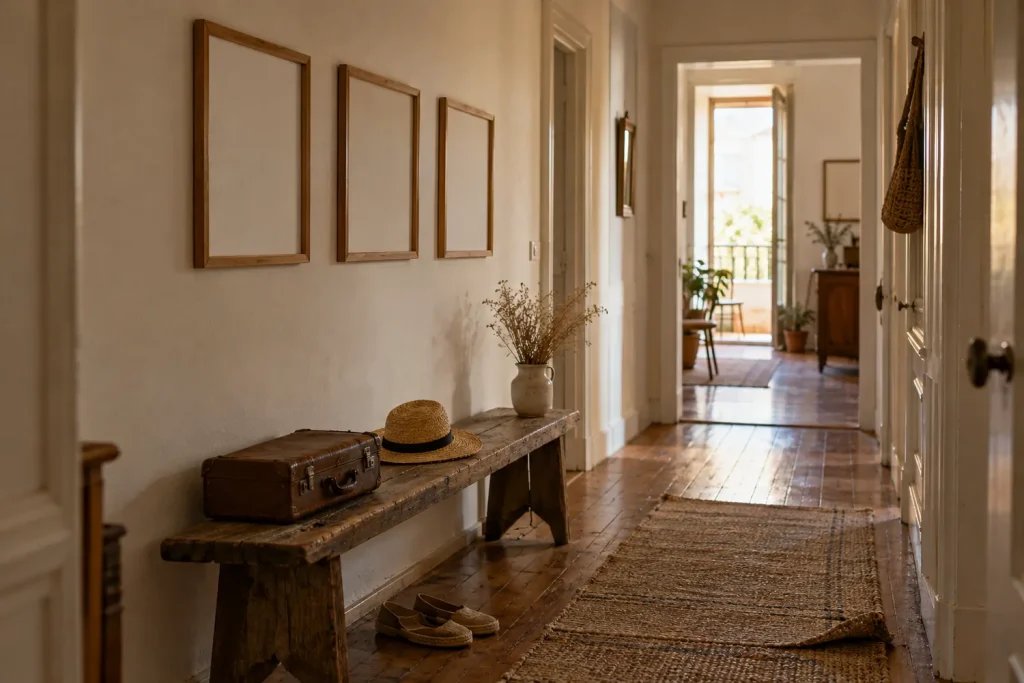
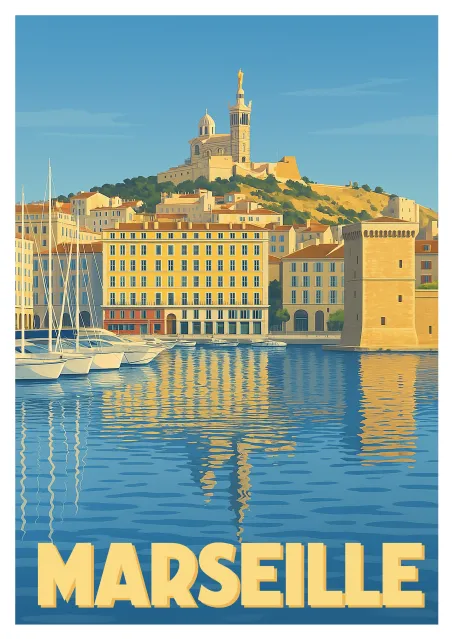
PLM posters were read as a series, on station walls. Do the same: three posters of the same size, lined up in a hallway or entrance, like the stages of a journey from Paris to the Mediterranean. Before drilling, follow our guide on how to hang a picture frame at the right height.
Our posters along the old PLM routes
Frequently asked questions
What does PLM stand for?
PLM stands for Paris-Lyon-Méditerranée. It is the usual name of the Compagnie des chemins de fer de Paris à Lyon et à la Méditerranée, founded in 1857 and merged into the SNCF on 1 January 1938. It served the French Riviera, Provence and the Alps in particular.
Who was Roger Broders?
Roger Broders (1883-1953) was a Parisian poster artist and a leading figure of Art Deco. Between 1922 and 1932, he drew dozens of posters of the Riviera, Provence and the Alps for the PLM, recognisable by their large areas of flat colour and deep perspectives.
Are Roger Broders posters in the public domain?
In France, a work enters the public domain 70 years after its author’s death, on the following 1 January. As Roger Broders died in 1953, his posters have been in the public domain since 1 January 2024. This is not the case for Cassandre, who died in 1968.
How much is an original PLM poster worth?
The price of an original PLM poster depends on the artist, the destination, its condition and its rarity. Originals in good condition generally sell for a few hundred to several thousand euros at auction. Modern reproductions cost a few dozen euros.
What is the difference between a PLM poster and an SNCF poster?
PLM posters were commissioned by the Paris-Lyon-Méditerranée company until 1937. From 1938, the SNCF, which brought together all the major railway companies, took over and in turn commissioned travel posters for the whole of France.
A century later, the same promise
PLM posters were not selling train tickets but a dream: sunshine, the sea, the peaks. A century later, they have lost none of their power. To keep exploring, read our other articles on poster art, and browse our France posters to take home a little of that light yourself.